Showing posts with label meat. Show all posts

Sunday, March 10, 2019

Instant Pot Methi Daal Gosht


Ingredients:

2 lbs medium bone-in goat botis, wash and marinade in pinch each of turmeric, red chile powder, and garam masala

From a bag of Indian frozen methi, remove 4 cubes (they are about the size of lemons), microwave for 4 minutes, allow to cool, and strain any remaining water content (press with fork or squeeze).

1/4 cup oil
 1 tsp whole cumin seed
1 onion finely sliced 
1 tbsp ginger-garlic paste
2 medium tomatoes pureed
1/4 tsp turmeric
2 tsp coriander powder
1 tsp cumin powder
1 tsp red chile powder (or to taste)
1 tsp salt or to taste
1/2 cup chana daal rinsed, keep soaking in water until ready
1.5 cups water

To finish:
Three fresh green chiles, whole
Pinch qasuri methi
Pinch garam masala
Pinch elaichi powder


Method: On Sautee mode, heat oil. Add in cumin seeds and onion. Fry onion until it is golden reddish brown. Stir in gg paste and allow to color. Stir in tomato puree, toss in dry spices, and stir until the oil separates and it is dried up a bit. When it looks dry, add in methi and fry for a few moments. Add in salt. Add in meat and mix well. Strain chana daal, then add it to the pot, stir in water. Cover and cook on bean/chili setting. Allow natural release. Open pot and mix well. Stir in finishing ingredients and allow to rest for a few moments. Serve with fresh roti or plain rice.

Friday, July 3, 2015

Fatima's Yakhni Pullao (Goat)

Fatima’s Yakhni Pullao

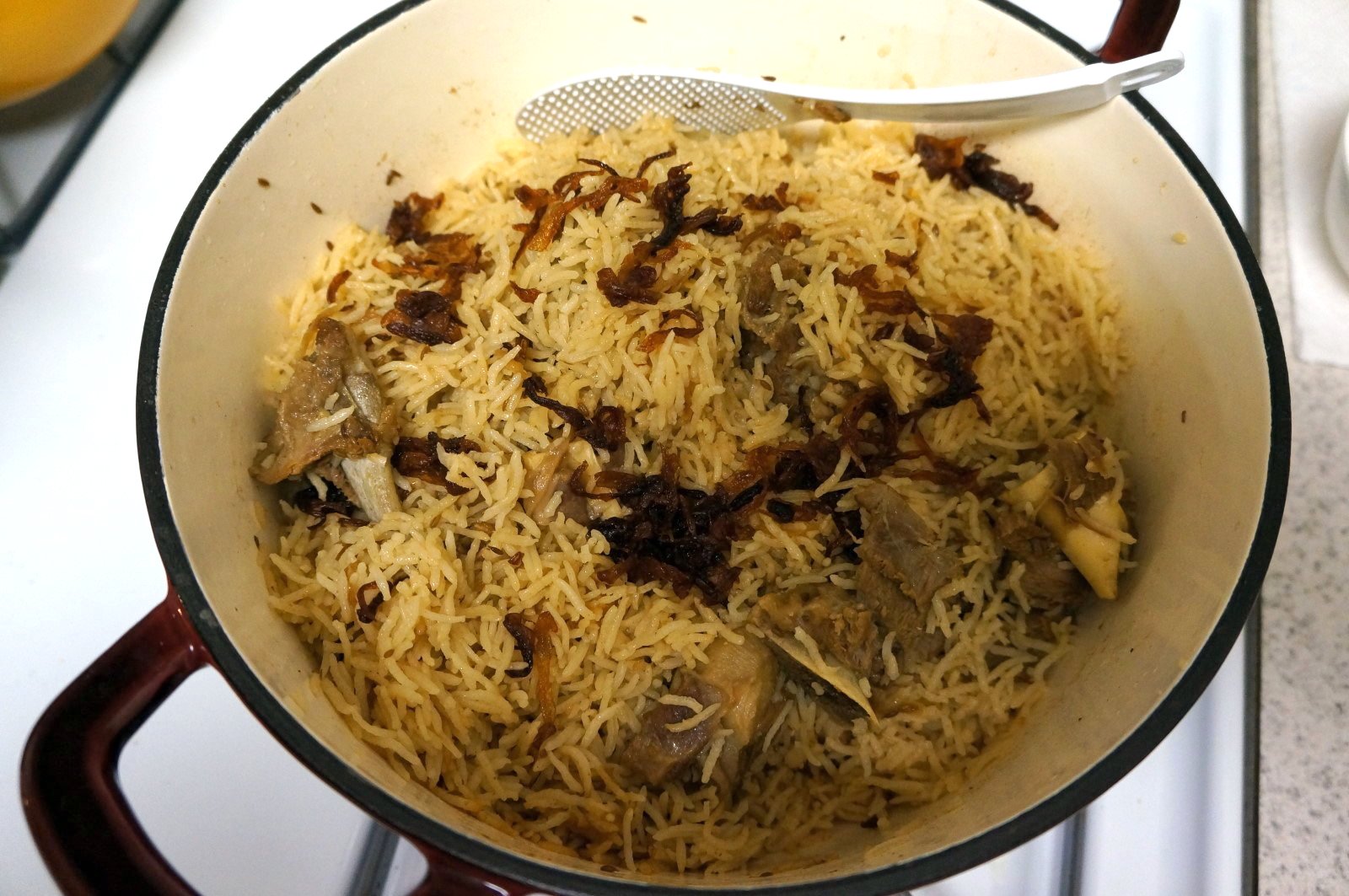
Yakhni pullao ready to serve for large gathering.


Yakhni means broth. This pullao is cooked in a golden, collagen rich, fatty goat broth. It is one of my husband's favorite dishes in my repertoire, and I like it a lot, too. It is not chile-hot at all. It's a great weekend dish for the family, but it's also a good fancy dish for a party because it shows "mehmaan nawaazi" that you are serving a lot of meat and high quality basmati rice. A deep stock is enriched by the addition of nalli, or bone marrow. 

*Take note that most of the pics I've added are from a day when I made this pullao for a daawat/party, but I'm giving a family sized recipe. That is why there are greater portions of ingredients than what I specify in the instructions. That day, I used a whole goat shoulder for my iftar party, 7 cups of rice, and 14 cups of yakhni.

The meat: Get about 2 pounds of goat meat, bone-in in medium botis (roughly 2-3 inch cube-ish size). Shoulder and chop pieces preferred. Ask butcher for about a pound of extra goat bones in a separate bag, especially nalli (marrow) bones, and trotters.  Desi halal butchers usually keep bags of this frozen. If you have a knowledgeable butcher, just ask for small to medium pullao cut pieces. If the pieces are too small, they will break apart when cooked.

On the left are the extra bones, on the right is a full shoulder with chops. I have washed this meat in my (spotlessly clean) kitchen sink.


For the yakhni (yields about 10 or so cups of stock)

Ingredients:

water to cover meat and bones in pot
1 onion peeled and cut in two halves
15 cloves garlic
about 5 inches of ginger chopped into large chunks (no need to peel, but wash well)
3 tbs whole garam masalas (I buy a bag of mixed whole garam masala, I think Deep brand)
make sure to get a couple of pieces of cassia bark, bay leaves, bari elaichi, and choti elaichi in the mix which will mainly be tiny pods of dhaniya, saunf, zeera, laung, and kali mirch. My mix also has star anise and mace (javitri).
2 whole dried red chiles
salt


Method:

Wash meat/bones well. Add to deep stock pot. Add water till the water just covers the meat. Too much water makes a weak stock.

Allow the water to come to a boil. Skim the scum that rises to the top a few times. When you have gotten most of the scum, add in all aromatics and sabit garam masala, and chile pods.

Scum to be skimmed off of the top of the broth before the seasonings are added.

Cover, lower heat to the lowest flame, and simmer for 1 hour and 15-30 mins till meat is very tender but not completely falling apart, and nalli looks loose from bones. My meat here in VA takes 1.5 hours to soften or “gallofy,” but in other places it only took 1 hour to 1.25 hours so use your best judgment on the timing. You don’t want the meat hard and spongy, you don’t want it shredding apart bc you still have to cook the rice and meat together.

About 5 mins before meat is done, add a large amount of salt to the stock. This will flavor the meat. You will still need more salt once the rice process begins.

Strain yakhni and keep the solids aside and allow them to cool. When cool, pick out all of the good meat pieces and keep aside. Now take a Japanese or Korean chopstick, which has a very thin pointy end (or similar thin pronged instrument, unused earwax cleaner, I dunno what else…linking pics so you get the idea of what to use) and use it to gently nudge the nalli out of the bones. Add nalli globules to stock. If you cook meat for a long time, the nalli will fall out on its own, but that would be too long a stage to cook the botis, so better to cook it till it is soft but still needs to be scooped or tapped out.

So you have your nalli floating in stock, and your good meat kept aside. Now throw away all of the spices and aromatics because they have done their job. You can keep a little of the tezpatta and cinnamon for looks if you like.


For the rice:
I use India Gate (Classic) brand rice. You should use your judgment for typical soaking and cooking time requirements of your preferred basmati rice brand. Don't use sella rice or any low grade of basmati. Three cups of raw rice to 6 cups stock will be needed. A 1:2  cup rice:stock ratio is used no matter the size of the pullao.

Ingredients:

3 cups basmati rice rinsed well and soaked for approximately 10 minutes (will be strained shortly before adding to the boiling stock)
6 cups stock
salt to taste (about 2.5 tsps or more…use more salt than you think you need)
1 tsp red chile powder
1 tsp zeera seeds whole
1 tsp ground zeera
¼ cup oil (same oil for frying finely sliced onions is ideal, I always keep it in a glass jar)
your boiled meat botis, cool and dry
1 tbs fresh lemon juice
1 tsp ghee or butter for basting the serving dish


Method: 

In a pot with a tight fitting lid: Add oil and zeera, when it sizzles, toss in meat and brown for a couple of minutes. Be gentle so it doesn’t break apart too much. The browning gives flavor but it is already cooked as much as it needs to be.

Toss in ½ o f the fried onions and allow to sizzle for a moment, these are red-brown fried so take care not to blacken them as they are already darkly fried.

Toss in ground spices, allow to sizzle. Before this burns, pour in all of the stock. Allow to come to a boil.

When stock is boiling, add in pre-soaked rice.

Allow stock to come to a boil again. Stir in lemon juice.

All should be bubbling and boiling along nicely. Now, cover and reduce flame to lowest point. Cook for 20 mins covered. After 20 mins, lift lid and allow some steam to escape and turn off flame. Re-cover and allow rice to rest for 10 mins. Resting the rice helps grains stay long and not break apart, as basmati is sensitive.


You will pour this into a large serving dish. I usually butter a deep serving dish like a lasagna pan or turkey broiler pan. Ghee also works well if you prefer that to butter. Before you start the transfer of vessels, put your remaining fried onions in the microwave for about 30 seconds to wake up the flavors. Pour pullao in layers adding a few sprinkles of the fried onion slivers between the layers, adding a final bit on the top layer for looks. Take care not to break the rice, be gentle.

Serve with plain yoghurt, lemon wedges, and if desired, a mild raita.

Left over yakhni can be frozen and used for a plain pullao or as the liquid in gravy. 


A smaller pullao made on a different day.

Rice grains lengthen like noodles and are very tender but separate. 


Wednesday, August 15, 2012

Dum Ka Qeema Smokey Keema

Smokey and delicious dum ka qeema
Here is my dum ka qeema recipe. I served this dish at an iftaar recently and a friend kept demanding that I give her the recipe. Since I wrote it down for her in an email, I decided to post it here on my food blog.

This recipe is adapted from Zubaida Tariq's Kitchen (p. 72)...I'd like to link that book, but oddly I cannot find the English version online. (I know I've seen it before!) I purchased the book in Pakistan years ago.

This dish is a favorite of mine, and it is so good that you end up eating more ground meat than you ever imagined you could consume in a single meal. It's something about the smokey flavor that makes you unable to stop indulging.

Ingredients
ground meat (beef or mutton, fatty is good)-2 lbs
yoghurt-1.5 cups whipped 
ginger/garlic paste-2 tbsp (one of each)
onion-1 (Already brown fried tali hui pyaaz)
mint-1/2 cup fresh leaves
green chile-4 (chopped roughly for grinding)
lemons-juice of 2 lemons, plus some lemon slices for garnish
unripe papaya (kacha papita) with ground with skin-2 tbs
khashkhaash (white poppyseed)-2tbsp roasted and ground
bhune hue channe (chilke wale)-2 tbsp roasted and ground to powder 
OR if you don't have it -2 tbp besan toasted in a pan
red chile powder-1 tbs
garam masala 2.5 tsp
black cumin (shahi zeera)-1/2 tsp
salt-1 tsp or to tasteoil-1/2 cup or so (maybe even 1 cup!)
1 cup water
plus 2-3 tbs more oil for dhungar


1 small piece of coal for giving dhungar

Garnish: fresh mint leaves, sliced raw onions (rings look especially nice), lemon wedges

Method:

Grind fried onions, gg paste, green chiles, mint, and juice of onelemon together. Mix this into the yoghurt. Add this into the meat and add in the khashkhaash, ground bhune hue channe/besan, 1 tsp red chilepowder, 2 tsp garam masala, and papaya. Mix well. Allow to rest forone hour. This will allow the meat to soften from the papaya. Don'tleave to marinade for more than one hour or the papaya will turn yourmeat to paste.


Heat oil in pan. Add in qeema and stir on high heat till the water dries up. This will take a long time. Like maybe 7-10 minutes. When it looks dry, add in salt and 1/2 cup water. Mix in, allow to come to a boil, then simmer covered for 15 minutes on low flame. Now turn up the flame and bhunofy it for 10 more minutes until it looks very brown. Sprinkle a little bit of water from the remaining half a cup you have to prevent any burning or sticking. You have to keep stirring and stirring and your arm will hurt, but when it is brown colored, it is done cooking. As long as it is well browned, you don't have to dry up any extra water you put in. It shouldn't be so extremely dry as to be crumbly, and should be tender. The ghee/oil as well as the water used at the end will keep this dish moist.


Giving dhungar (perfuming with smokey flavor): Now heat up your coal on the stove. When it is hot, make a cup out of silver foil (or use a cup made out of a single large onion petal) and put ghee or oil into that cup (2-3 tbs). Put the foil cup filled with oil into the pan with the cooked qeema. Place the hot coal into the oil and quickly cover. Allow the smoke that rises to penetrate the qeema for about 20 minutes or until the coal is cool.When the coal is cool, remove the foil and coal but pour the extra smokey oil into the qeema. Mix this oil into the qeema and also add in1/2 tsp more garam masala and 1/2 tsp shahi zeera. Before serving, stir in juice of one more lemon. (To prevent a house fire, take care to put the leftover burnt lump of coal in a cup of water for a while before disposing, and don't just throw it directly into the trashcan even if it seems completely cool.)


Top with garnishes and serve.

It is a fattening and arduous dish but very delicious. It is traditionally served with parathas, bhatooras, or puris. Naan works, too. It can also be rolled into paraathas along with sliced onions and tamarind chutney for dum ka qeema roll.


Variation:

Dum ke kabab

Use only 1 cup of yoghurt, but keep the rest of the ingredients the same. After one hour of marinading, do as follows: Do the dhungar process on the raw meat. Shape meat into hamburger patty shaped kababs or oval shapes, and pan fry in a little bit of oil on medium heat, nicely browning each side and cooking through thoroughly.

Saturday, April 9, 2011

Roghan Josh

Roghan Josh, also spelled Rogan josh, is a well known Kashmiri dish.  From Persian, "roghan" means ghee/oil/butter/fat and "josh" means like bubbling hot with excitement...so it is like "hot bubbling fat." What a fatilicious name!


There are a lot of roghan josh recipes on the internet. Most are faux Mughlai/Punjabi restaurant style recipes and contain cream and tomatoes, neither of which are found in Kashmiri Pandit or Waza Roghan Josh recipes. It is actually pretty hard to google up an authentic recipe without some digging and research. For some basic info on Kashmiri Pandit and Wazwan cuisines, see here.


I wanted to share two recipes for Roghan Josh that I acquired after a lot of hunting online. I have tried them both multiple times, and they are both good. One is a Pandit recipe, and the other a Muslim recipe.


The Pandit style recipe I found at the another subcontinent forums from poster Suman. (post #1) (The Another Subcontinent forums has a wealth of anecdotal South Asia food information, tips and recipes. Every once in a while I just sit there and read food threads for a hour.) 


Rogan Josh.


(somehow blogger is not letting me link above anymore so I linked the source here)

1 llb lamb, cut into small pieces
couple tblsp mustard oil or substitute.

4 cloves/laung
1" dalchini/cinnamon
2 black cardamom
couple small bay leaves

1/4 tsp hing
2 tsp saunf/fennel
1/2 tsp sonth/dry ginger powder
salt, chilly powder

4 powdered green cardamon
1/4 cup yogurt, beaten till smooth.

Saffron optional.

In the hot oil put in the whole spices(cloves, cinammon, cardamom, bay leaves) and stir for a few seconds till fragrant. Add the lamb and the hing and fry on fairly high heat until speckled with brown. This should take between 5 to eight minutes. Add the saunf, saunth, chilly powder, and salt and fry for a minute or so. It should be pretty fragrant by now.

Reduce the heat, add the beaten yogurt and powdered green cardamom and keep stirring till it comes to a boil. Add 1/2 cup of water, cover and cook till done. In LA the lamb takes about 30 minutes to cook, so adjust cooking time and the quantity of water.

Saffron can be added when done and simmered for a couple minutes more.

The resulting gravy should have body, should not be watery and is served with rice.

A green vege, stir fried with a tadka of a pinch each of hing and clove powder plus a whack of chilly goes very well with this.


I pretty much followed Suman's recipe to a T, but I used bone-in mutton and cooked for 1 and a half hours till tender, not 30 mins, I used sunflower oil (I don't like the taste of mustard oil), I powdered the saunf/fennel seeds and beat it in with the powdered cardamom, and I did not use saffron. It came out very nicely.


The second recipe was posted here by a Ms Princess W in the India Mike food section (post #55) by a US origin lady married to a Kashmiri Muslim and living in Indian Kashmir. At the time she posted, she was learning Kashmiri Muslim style cooking from her in-laws. I also recommend that you read through that entire thread as she and other posters share more information on Roghan Josh and Kashmiri cuisine.


Roghan Josh


(once again fickle blogger is ignoring my instructions to hyperlink above, so source is linked here)


1 kg lamb, bone in

1/2 to 1 cup Mustard Oil

3 Onions, sliced thin

3 cloves garlic

1 teaspoon minced ginger

1 1/2 cup plain curd, beaten to a liquid consistency

3 black cardamom pods

4 whole cloves

1" stick cinnamon

1 1/2 tsp salt

1 1/2 tsp red chili powder (if you want the red colour & more spice)

1 teaspoon turmeric powder

2 green chilis, minced

1 Tablespoon dried mint leaves

2 teaspoons fennel, ground (can use whole seeds if you prefer)

fresh coriander leaves, chopped


First, boil the lamb in a kettle of water seasoned with salt and one of the black cardamoms. Boil about 10 minutes and remove. Reserve water.

In pressure cooker, fry onions in oil until golden brown and somewhat crisp. Remove and grind the onions with the garlic and ginger to form a paste. Add cloves and minced chilis to the hot oil and fry about 30 seconds. Add lamb to the oil and brown just a little, then add the rest of the seasonings and about 2 cups of the reserved lamb broth. Place the cover on the pressure cooker and let it come to full pressure. After 3 or 4 "whistles", reduce heat and continue to cook for about 20 minutes. Remove from heat and let cooker cool naturally before opening.

Check the tenderess of the meat. If it comes off the bone easily, it is ready. Add the beaten curd to the pot and stir well. Let the Roghan Josh simmer on very low about 1/2 hour to blend the flavors, then let stand about 1 to 2 hours, or better yet, refrigerate, then heat n serve the next day, topped with the coriander leaves.


Here is my picture of the rendition of Ms Princess W's recipe.


 I used chaampen or mutton chops rather than botees as that is what I had on hand that day. Nice hot fat floating on the top, eh? And check out the red color! I did not pressure cook the lamb but cooked it stove top. Ms Princess W doesn't mention cockscomb here, but I also added paprika instead of more red chile powder to imitate the color of Kashmiri cockscomb flower, which obviously is hard to procure outside of Kashmir. Paprika is a good option instead of extra red chile powder since obviously the heat factor would be uncharacteristically amplified by extra chile. I also omitted the dried mint because I didn't have any. And just like with Suman's recipe, I forwent the traditional mustard oil simply because I am not a huge fan of the taste. It was a nice dish, and with the Kashmiri waza method of adding seasonings to a yakhni/broth and perfuming a dish with fennel, this dish was very distinct from my typical daily tamaatar-pyaaz Pakistani saalans.


I often create my own recipes by adapting and combining recipes from friends, in-laws, books and online, and altering methods and ingredients slightly to suit my taste and cooking style. Here you have two simple and authentic recipes that you can do the same with.

Friday, February 11, 2011

Qorma Biryani of Lucknow

My husband's mother's family is from Lucknow, Uttar Pradesh, India. This city was a seat of North Indian Muslim culture and the Urdu language, and this is a great source of pride to my mother-in-law. Qorma biriani is the preferred type of biriani in their family home. Qorma biriani is not particularly spicy. Its virtue comes from the richness of the ingredients, the warmth of the garam masalas, and the savory red-brown fried onions. The toasted ground white poppy seed, or *khashkhaash (khaskhas in Hindi), and the mace and nutmeg are also characteristic seasonings of Lucknavi cuisine.

The onions give a lot of flavor, but be light handed with them in layering with the biryani rice. You don't want an overpowering fried onion flavor hiding the delicious yet delicate qorma flavor. Traditionally, only the highest quality Dehra Doon basmati rice would be used, so you must use the best basmati rice you can find. I like Tilda as well as India Gate brand.

*If you are not familiar with white poppy seed, here is how to use it. Purchase it at your local Indo-Pak market. Black poppy seed is NOT an acceptable substitute. Heat a pan to medium-high, pour in white poppy seeds and toast until they become a darker color and you can smell their roasted nutty fragrance. Once toasted, set on a plate and allow to cool. When cool, grind to a smooth paste (it will be very slightly gritty) in your spice grinder. Store in the freezer, as it goes rancid like nuts. I grind in small amounts and keep mine in a ziplock baggy in the freezer.

The Qorma

¼ cup oil
1.5 lbs bone-in mutton pieces in 1-2 inch chunks, ribs and shin meat best
2 medium onions finely sliced, brown fried, and crush half of them, keep the other half uncrushed
6 green cardamoms, husk popped open by pressing with knife
2 black cardamoms (bari elaichi)
2 bay leaves (tez patta)
1 piece of cinnamon bark, about 2 inches long
1 tsp garlic paste
1 cup yoghurt with ½ tsp garam masala , 1 tsp red chile powder, and 1 tbs ginger paste whipped in
12 skinless raw almonds  soaking in warm water to just cover
1 tbs toasted ground white poppy seed
1 cup water
¼ tsp mace powder (jaavitri)
¼ tsp nutmeg powder (jaiphal)
1/4 tsp freshly ground green cardamom powder
1/2 tsp garam masala powder
1 tsp salt or to taste

The Rice
½ tsp kewra jal (pandanus flower water)
¼ tsp  orange food coloring powder (biriani rangi) soaked in ½ cup milk 
3 cups raw rice parboiled with a few green cardamoms (see here for method)
3 tbs butter or ghee

Garnish: mint leaves, some extra fried onions

Method

Have crushed, fried onions on hand.  Grind soaking almonds with their water to make a paste.

Heat oil and add in whole spices for a minute. Add in meat and brown well, add in garlic paste and allow to turn golden, lower flame add in yoghurt mixture, stir to mix well on low heat (to avoid curdling yoghurt) when oil rises above yoghurt, turn up heat and stir in white poppy seed and, mix well. Stir in one cup water and salt. Bring to boil, lower heat , and cook for 1.5 hours until mutton is tender  and falling off bone. Stir occasionally. Add a tiny bit of water if necessary, but you want a fairly dry clinging gravy at the end, so don’t add too much water. If you have too much liquid at the end of cooking, turn up the heat for a few minutes to boil out any excess water. Finally, stir in the crushed brown fried onions, and all of the additional powdered spices, and ground almond paste. Keep covered on a very low flame for five more minutes. Set aside.

Have the uncrushed fried onions on-hand for layering.

To see a more detailed explanation of how to layer biryani, look here at my Sindhi biryani recipe.

Have your parboiled rice ready. In a deep pot, put in some ghee/butter and then a layer of biriani gravy. Add a layer of parboiled rice, then top with a sprinkle of fried onions and ghee/butter, another layer of qorma, another layer of rice, ghee, and fried onions. On the final layer of rice, pour your orange milk in one small spot on the rice. Sprinkle with kewra jal. Put the pot on a high flame, covered for 3 minutes to get the steam going. Then lower heat and cook 20 minutes until rice is done. Allow to rest, then mix and serve on a platter garnished with mint leaves and a bit more fried onion.

Serve with lime wedges and plain yoghurt, not a raita.

Monday, May 17, 2010

Shan ki Shan: Sindhi Biriani


Some people will tell you that using Shan Masala is cheating. I say no way. Using Shan masala is perfectly fine if the end result tastes good. Shan is an auxiliary item. It doesn't create the 'maza' for you. Besides, no one just uses the packet of Shan Masala. Everyone always adds in their own medley of spices to a couple of spoonfuls of Shan for a dish. I have a post in mind about the rise in popularity  of Shan's connection to the birth of modern Pakistani cuisine. Shan has contributed to the homogenization of a diverse food culture in the young nation of Pakistan.  But in this post, I'd like to share with you my recipe (with a little help from Shan Uncle) for Sindhi biriani. Many people swear by Shan's Sindhi biriani mix. I use it, too as my favorite biriani. Here is my doctored up Shan masalay ki Sindhi biriani recipe. I add mango powder and extra dried plums (aloo bukharay) to the Shan masala to get a hot and sour taste in the finished biriani. Using Shan doesn't make it a bit easier, it is a complicated process. But it turns out great:

For the meat gravy you need:
1/2 cup of oil (which will be poured off of the gravy later, don't worry)
1 kg (2.2 lbs) of bone in mutton cut in large chunks (say 2/2 inch botees)
1 tsp whole cumin seeds
2 onions finely sliced and fried until crisp and brown (bhuni hui pyaaz)
1 tbs garlic paste
2-3 tomatoes roughly pureed
1 heaping tbs salt
1 tbs ginger paste
1 cup yoghurt
1.5 tbs Shan Sindhi Biriani Masala Mix
1 tsp coriander powder
1 heaping tsp ground mango powder (aamchoor)
1 tsp red chile powder
1 tsp garam masala
+/- 1 cup water
12 alu bukharay (dried plums/prunes available at Pakistani grocery)


Aloo Bukhara


Method: Mix the yoghurt with the powdered spices and the ginger paste and set aside. Heat oil in a pot and brown meat in two batches. Set the meat aside. Add cumin seeds, fried onions, and garlic paste to the oil.  Take care not to burn the onions. When the garlic is golden, stir in the tomato puree. Stir this for a while until the water has evaporated from the tomato puree and the oil is rising to the top of the gravy. Add in the salt. Stir in the meat and mix well. Turn down the heat and stir in the spiced yoghurt (lowering the heat will prevent the yoghurt from splitting). Mix well and turn up the heat again. Stir until oil rises to the top of the gravy. Add in the water and the aloo bukharay. Allow to boil, cover, simmer on low heat for about 1.5 hours until the meat is nicely tender. When it is done, remove the meat and aloo bukharay from the gravy with a slotted spoon. Turn up the heat and evaporate the remaining water from the gravy. You will have a thick biriani masala paste. Pour the oil that rises to the top of this paste off of the gravy to cut calories and to avoid a greasy biriani (yuck!). Add the meat and the aloo bukhary back to the dry gravy paste and keep ready for the rice. *You can add potatoes to this recipe. Peel and halve 3-4 potatoes and add in in the last 40 minutes of the gravy's cooking. Remove the potatoes at the same time you remove the meat for drying up the gravy.


For the rice:
3 cups of uncooked biriani grade basmati rice cooked according to these instructions: Lucky Delicious on How to Cook Basmati Rice  parboiling method. You will soak and parboil the rice according the specifications for biriani rice. Do this after the biriani gravy is done cooking. You will layer the rice with the biriani gravy in a pot soon after you have finished parboiling it. Take care to be gentle with the rice so as not to break the kernals.


Unmixed layered biriani before covering to fully cook (put on dam)

Perfuming the biriani:

16 fresh mint leaves
8 fresh whole green chiles, slit
1/2 tsp Kewra Water (available at the Pakistani grocery -keora jal-)
1/8 tsp of orange biriani food coloring added to 1/2 cup milk


mint and chiles


Bush brand biriani coloring, coloring mixed in milk, keora water


What to do: You have parboiled your rice. You have made a biriani gravy. Take a vessel and use a paper towel to grease it lightly with ghee. Add in a layer of meat and gravy. Distribut half of the mint leaves on top of this, and throw in half of the slit chiles. Now add in half of the rice. On top of this, add in another layer of meat gravy. Top this with the rest of the mint leaves and slit green chiles. Then add another layer of rice. Drizzle the rice with the keora water. Pour the orange colored milk into one area of the biriani rice. Now cover with a kitchen towel and close the lid. Put this on a high flame for 3-4 minutes to start some steam going in the pot. Then turn down the heat to the lowest setting and allow this to cook for about 18 minutes to finish off the rice and to allow the gravy and rice flavors to blend together. This step is called cooking on 'dam'.


biriani cooked on dam in a Sindhi sipri


When the biriani is cooked, turn off the flame and lift the lid to allow some steam to escape. Allow the biriani to rest for at least 10 minutes before mixing and serving it. This allows the rice to settle so that it won't break when you stir it. After the biriani has had a nice rest and you are read to serve, mix gently and set out on a serving dish. Garnish with finally chopped cilantro. Serve with plain yoghurt.


Freshly cooked and mixed biriani

Thursday, April 15, 2010

Shahi Kababs and the Dalda Cookbook

The Dalda Cookbook is probably the best known English language Pakistani cookbook. It was produced by the Dalda Cooking Oil company. It is available online (have a google) and as I frequent Pakistani and Indian food websites, I have seen many, many recipes plagiarized directly from that book (and also Zubeida Tariq's book From Zubeida Tariq's Kitchen...the other English language Pakistani cookbook, this one with a Hyderabad Dakkani twist). It seems that EVERYBODY has the Dalda Cookbook. The married women in my in-law's family make jokes about it. My mother in-law gave me a copy when I got married. I don't know much about the history of the cookbook or how it came to be so popular. The recipes are scant and simple, but often turn out very well. On the ground, what Pakistanis eat is a collection of regional cuisines based on the diverse regions of Pakistan, and the cuisines tied to history of immigration to the nation that became Pakistan after the partition of India. What is French cuisine? The cuisine of Paris is not the cuisine of Provence. What is American cuisine? We can give generalized answers for the sake of easy explanation. So what is Pakistani cuisine? The Dalda Cookbook exemplifies Pakistani cooking because it contains recipes for every one of Pakistan's iconic dishes, as well as some changed-up, experimental, or international dishes for good measure. Anyhow, I have cooked a lot based on the Dalda recipes. I would like to know more about this book. Who put it together? When was it first published? How many editions are there? Was there ever a show based on it? What is the backstory?

One of the "changed up, international" recipes in Dalda is for Afghani kababs on page 2 of my copy. It is a simple yet interesting recipe in which one makes pan fried minced meat patties, slices them into rectangular-ish kababs, and adds these kababs to a tomatoey (karhai type) gravy. The recipe has no dried spices in it besides black pepper. This makes me suspicious that it is not a true Afghan recipe. There is this myth among Southern Pakistanis and also Indians who know of Pashtoon and Afghan food that in the Afghan culinary belt, the people only use salt and pepper to season their food. I feel that I have read this in a Lonely Planet edition as well as somewhere in a Madhur Jaffrey book. My mother-in-law has told me this as well. However, all evidence I have of actual Afghan and Pashtoon cooking indicates that this is a complete myth. Pashtoon cooking is regional as well, but generally the entire belt uses a spice mix seasoning that is essentially the same thing as a simple garam masala. So they DO use masalas. I own an Afghan cookbook and two other pan-regional cookbooks that have Afghanistan sections. I also have some down-the-street neighbors who are Pashtoons. In the recipes of these books and of my neighbors, there are multiple garam masala type spices used. The food is just not as chile hot as Southern Pakistani cuisine. However, some Pashtoon recipes which I have seen online also contain a lot of chiles, green and red. So it seems that this whole "salt and pepper" Afghan cuisine thing is not true. I wondered to myself what this recipe would taste like if it were more highly seasoned it.

Anyhow, once a long time ago, I made this recipe. It is 'different' compared to the typical meat saalans (gravy or "curry" dishes) that I serve regularly, so it was fun to make and serve. Somehow, I kept coming back to this recipe as I thumbed through the Dalda Cookbook. I wanted to make it again. But I wanted to change it. So I took the idea, plagiarized it if you will, and changed it up completely. I added in "Mughlai" touches like poppy seeds, cashew nut paste, as well as red chiles.

So here is my totally changed up Dalda Afghani Kabab recipe. It is the same concept of making a seasoned meat patty, cutting it into strips for 'kabab' and then adding these kababs to a tomato gravy. Other than that, it is a totally different recipe:

Shahi Kabab*


The kababs: Combine in a mixing bowl the following ingredients

1 lbs minced beef or mutton
1/2 onion pureed
1 tsp garlic paste
1 tsp ginger paste
1-2 green chiles ground to paste
1 slice of white bread soaked in milk, squeezed to drain the milk, added to the bowl
1 tbs of cashew paste (soak 10 cashew nuts in just enough warm water to cover, then puree to grind to a paste with the soaking water)
1 tbs ghee
1 tsp freshly ground anise powder (saunf)
1 tsp garam masala
1 tbs white poppy seeds (khashkhaash)
1/2 to 1 tsp red chile powder
pinch of red chile flakes
1 tsp or so salt, or or to taste

Mix these ingredients together well, kneading them into the meat. Divide the meat into 3 portions and flatten these into large disc shapes about 1.5 inches thick. Heat oil in a frying pan and brown each meat disc on both sides. Don't worry about cooking the patties all of the way through because you will finish off their cooking in the gravy later. They should have a nicely browned outside, though. Allow the patties to cool, then cut into long strips. They will look kind of like rectangular-ish seekh kababs at this point. Set aside. TIP: before you fry all of the meat, take out a bite sized amount of meat, cook it in the pan, and taste it to check the salt and seasonings and adjust if necessary.

For the gravy:
1 tsp cumin seeds
1 tbs ginger-garlic-chile paste (just grind these together, 1:1:1 portions and use as needed for a week)
3 small-medium tomatoes, blanched and pureed
1.5 tbs crisp fried onions, crushed
1 tsp garam masala
1 tsp red chile powder
1/2 tsp turmeric powder
1/2 tsp ground cumin powder
1/2 tsp ground coriander powder
2 tbs whipped yoghurt
1/2 cup water
1 tbs cashew paste (see above kabab recipe to know how to prepare)
1 tsp dried mango powder (aamchoor)
1/2 tsp freshly ground cardamom powder
3 tbs oil
1 tsp salt or to taste

Heat oil in pan. Add in cumin seeds. When they sizzle, add in ginger garlic chile paste. When the garlic and ginger turn golden, add in the tomato puree. Cook this for a few minutes until the oil rises to the top. Add in the ground fried onions, turmeric, red chile powder, garam masala, cumin powder, coriander powder, and cook for a few moments to cook off the spices. Lower heat and stir in the yoghurt. Stir for a few minutes until the oil rises to the top of the dish again. Pour in the water and simmer on low heat for 5 minutes. Add in the dried mango powder and cashew paste, and salt. Add in the kabaabs now, and a dash of water if the gravy looks to dry. Cook covered, simmering on low heat for about 10 minutes, shaking the pan gently so that the bottom doesn't stick. When the kabaabs are cooked through and the gravy is semi-dry, it is done. Stir in the cardamom powder, mixing gently to distribute it in the gravy without breaking the kababs.

Serve with naan.

*Shahi means royal. Since these kababs are enrichened with Mughlai ingredients, I changed the name of the dish.

Friday, February 13, 2009

Kashmiri Style Ribs: Tabak Maaz


I have adapted the recipe from an old magazine clipping. The hing, ginger powder, fennel, and of course Kashmiri chile powder give the gravy a Kashmiri touch. This is a great party dish. It is tasty as well as easy. You can make it in a dry velvety clinging sauce (pic 1) by drying up the moisture in the gravy, or serve it in a more liquidy sauce (pic 2), as per your preference. You could also serve the wetter gravy as a dipping sauce on the side.

1 lbs lamb or goat chops (mutton chops or champein!)
1 cup yoghurt
1 heaping tsp ginger powder
1 tsp freshly ground fennel seeds
1/2 tsp ground cinnamon
1 tsp Chinese Five Spice Powder
1/8 tsp (pinch of) hing/asofetida
1 heaping tsp kashmiri chile powder
1 tsp garam masala
1 tsp or so salt (to taste)
1 cup water
3 tbs sunflower oil for braising
1/4 cup sunflower oil for pan frying

Blend all of the spices and into the yoghurt. Marinate ribs in yoghurt for a few hours or overnight. Heat 3 tbs oil in a pot and then add ribs. Add in salt now. Braise for a few minutes on medium heat until the oil separates from the gravy. Take care not to allow the yoghurt to curdle by keeping the heat controlled. Add in one cup water or so to cover the ribs, bring to a boil, then cover and simmer on very low heat for about 1 to 1 and a half hours until ribs are nice and tender. Remove ribs and set on plate to cool completely. Keep the gravy aside. At this stage you can boil off excess water from the gravy to thicken it. The ribs should be completely room temperature for the next step, in the meanwhile. Now heat the rest of the oil in a flat frying pan. Brown room temperature ribs in the frying pan by frying on each side. Serve on a flat plate and pour the remaining gravy on top of the ribs, or if youv'e done a ticker gravy, paint it on. If you do this for a party, you can wrap the end of the bones in foil.

This is a great go-to party dish and believe me people will suck the goat ribs dry!

Friday, October 17, 2008

Pasanda: Thin rump steaks stewed in seasoned yoghurt gravy

My mother in-law makes these a lot when she comes to visit because quite frankly they are so easy, and they taste good. My husband likes them a lot, too. These two pasanda recipes are adapted from her original recipes.

Garam Masala Pasanda

1 lb beef rump sliced into 1 cm thick steaks (ask the desi butcher for pasanda)
(I have also made this recipe successfully with pasanda sized slices of chicken breast)
1 cups yoghurt
1 tbs good garam masala
2 heaping tbs coriander powder (pisa hua dhania)
1 tsb red chili powder
1 tsp salt or to taste
2-3 tbs oil

Pound the meat slices, stab them with a fork, beat and abuse to tenderize. Whip the masalas with the yoghurt. Add in the meat and marinate over night, or at least for a few hours so the yoghurt can tenderize the beef. Heat oil, add the meat and marinade. Cook on high heat for about 10 minutes or so until gravy separates from oil. If you are using chicken breasts, lower heat and simmer for 10 more minutes and you're done. For beef, add in about 1/2 cup water, allow to boil briefly, lower heat and simmer for 1 hour or more until beef is nice and tender. You may need to add a little more water if it gets too dry. The gravy should be thick, velvety and separate from the oil at the end.

Pasanda in Ginger Garlic Gravy

1 pound pasanda beef slices
1 cup yoghurt
1 tbs garlic paste
1 tsp ginger paste
2 tbs crushed browned onion (bhuni hui pyaaz---I fry and freeze in large quantities, you will need to fry some up, say about 1 medium onion, if you don't have them on hand)
1 tsp red chili flakes
2-3 tbs oil

Mix the yoghurt and all the masalas except the browned onion. Add in the meat. Marinate overnight. Heat oil and add in the browned onion for one moment (don't blacken, just sizzle), then pour in the marinade. Braise on high heat for 10 minutes or so, add in 1/2 cup of water, bring to a boil, turn down heat, and simmer for one hour or until meat is tender.

I also like the Shan Masala pasanda recipe. Be careful of your beef slices being too thin because they should be tender but not falling apart, and shouldn't curl. Pasanda gravy should be fairly dry , but if you want more gravy, use 1/2 cup more yoghurt. If you want to make it dryer, use 3/4 cups yoghurt instead of 1 cups and add more water in the recipe, then just dry up the water at the end of cooking. Serve with naan or basmati rice.

Keema Qeema Queema: Spiced Ground meat

This queema recipe is from North India/Pakistan. It is spiced minced meat (could be beef or mutton) eaten with either plain boiled basmati rice or whole wheat flat bread (you could use whole wheat tortillas or pitas). It can be accompanied with plain yoghurt or raita if you like.

1 lbs ground beef
2 tbs oil
1 large onion chopped
1 heaping tsp finely chopped garlic
1 heaping tsp finely chopped ginger
1 tomato cut into small chunks
1-2 green chilies (optional)
1 tsp turmeric
1 tsp red chili powder
1 tbs coriander powder
1 tbs. cumin powder
1 heaping tsp garam masala powder
1 heaping tsp whole cumin seeds
½ cup water
Salt to taste
Fresh cilantro for garnish

First sautee onions in oil till transparent. Add in the whole cumin seeds while sautéing. Add in garlic/ginger allow to cook for a few moments (don’t burn). Toss in turmeric and red chili, stir for a moment and add the ground beef. Stir around until all the meat is browned and the juice has come out and dried up. Browning the meat well is a key step to achieve the correct desi flavor. Add salt, coriander powder and cumin powder, tomatoes, and green chilies. Stir a few times. Add ½ cup water and cover and cook on low heat for 30 minutes, stirring occasionally. Uncover and turn up heat, stirring for a few minutes to let it dry out just a bit. Add in the garam masala powder and stir again. Garnish with fresh chopped cilantro, and if you like it hot, another chopped green chili.

You can vary this by adding in potatoes (cut into large wedges), peas, green bell peppers, or eggplants. Traditionally you would only add one type of veg., not all together. You would add the veg in at the same time as you add the powdered coriander and cumin and before you pour in the water.

Channa daal ka queema:

Another variation is to add in firmly cooked channa daal, and you will have channa daal ka queema. To do this, soak 1/2 cup of channa daal in water for one hour. Boil then reduce heat and simmer for 20 minutes until daal is fully cooked, but firm and not falling apart. Stir this into your queema during the last 5 minutes of cooking. You will have to add more salt to your recipe to balance out the salt that the daal soaks up so that you don't end up with bland queema.

Bhuna Gosht


Bhuna is fried, brown fried to a crisp sort of. For bhuna gosht, the gravy should be very well fried and dried up, or bhunofied in Hinglish.

Yet another goat meat Pakistani family favorite. The end result should be a rather dry and thick velvety gravy paste.

2-3 tbs oil
2 finely sliced onions, fried until reddish brown (bhuni hui pyaaz)
1 pound bone in goat meat in stew sized chunks
2 tbs yoghurt
1 tomato roughly pureed
1 tsp ginger paste
1 tsp garlic paste
1 heaping tsp good garam masala
2 tsp ground coriander powder
1 tsp or so salt or to taste
1/2 to 1 cup water for the "dam"
chopped cilantro and green chilies for garnish

*TIP*I fry up large quantities of browned onions and freeze for use about once per month. It is a huge time saver to not need to caramelize onions for every dish that requires them, since they are so widely used in Pakistani cooking. For this dish, I use pre-browned onions. Be sure when you add them in to the hot oil, you do it shortly before you add in a wet ingredient to prevent them from burning.

Brown the meat very well, add in the fried onions, garlic, ginger, and fry some more. Add in the tomatoes, garam masala, dried coriander powder, and salt, and continue to stir on high heat for a while until oil rises from the gravy. Add in the yoghurt and stir until the yoghurt separates from the oil. Add in the water, the goat should be about 1/2 covered in water. Allow to boil, cover the pot, and simmer on very low heat for 1 hour and 15 minutes or so until the goat is nicely tender. When the meat is tender, turn up the heat to high again and stir around for a few moments to thicken the gravy a bit more, until you have a dark brown paste. I often remove the goat from the gravy and stir the gravy to thicken on high heat to get a very thick paste. Then I add the goat in again. The results should be a brown, very well bhunofied gravy that is fairly dry and clinging to the meat. This is what is "bhuna" about it and why it is different from a saalan. Garnish with the "green masala" or cilantro and green chilies.

Mutton Curry

Here is my recipe for mutton curry. I use Shan Masala Curry Powder. Another Pakistani home favorite.

2-3 tbs oil
1 kg bone in goat in stew sized chunks
1 onion chopped finely(the big yellow American onions 1, but if you use desi purple onions, use 2-3)
1 tbs garlic crushed
1 tsp ginger crushed
1 stick cinnamon
1 bay leaf
5 black peppercorns
1 tsp whole cumin seeds
3 whole dried red chili pods
1/2 tsp turmeric powder
1 tsp red chili powder
1 tsp coriander powder
1 tsp cumin powder
2 heaping tsps Shan Curry Powder
1/2 cup yoghurt
2-3 tomatoes chopped
2 cups water
2 tbs Qasoori Methi (dried fenugreek leaves)
1 tsp lemon juice
1 tsp salt or to taste
chopped cilantro and green chilies for garnish

First brown meat for a few moments and then remove from oil and set aside. On high heat, add in this sequence cumin seeds, whole dried red chilies, cinnamon, bay leaf, peppercorns, onions, stir around till onions become translucent and lose a lot of moisture...you may need to turn down the heat if they start to brown. They should just be sauteed, not browned in this dish. In the mean while, add in the ginger garlic. When the onions are sauteed and the ginger and garlic is cooked, add in this sequence the turmeric, red chili powder, cumin powder, and coriander powder. Allow to sizzle for one moment, then add in the tomatoes, stir to melt down for a few minutes, then add in the yoghurt and for a few moments, add your salt and Shan Curry Powder now. Then, add in the browned goat. Pour in the 2 cups water and then allow to boil briefly, then cover and simmer on very low heat for 1 hour and 15 minutes or so until the goat is very tender. Now turn up the heat, (if the curry looks dry for your taste, add up to 1/2 cup water) and add in the dry Qasoori methi, stir around for a moment. Add in the lemon juice, stir, turn off heat, and garnish with green chilies and cilantro. Serve with chapattis or basmati rice.

Alu Gosht

Alu gosht is meat and potatoes. It is a Pakistani home cooked standard.


You will need:
2-3 tbs oil
1 onion sliced finely
1 tsp crushed ginger
1 tbs crushed garlic
1/2 tsp turmeric powder
1 tsp red chili powder (or use less for less heat)
1 tsp coriander powder
2 large tomatoes chopped
1 kg bone in goat meat cut into 2 inch chunks
3-4 potatoes cut into large wedges or even just halved
salt to taste, like about 1 heaping tsp
1/2 tsp ready made garam masala spice mix
chopped cilantro and chopped green chilies for garnish

First you have to brown the onions. Fry them in oil on very high heat, when they have lost a lot of moisture, turn down the heat and allow them to turn reddish brown, stirring occasionally. This will take maybe 1/2 cup of oil, so you can strain them from the oil, take out your oil for the rest of the dish, and set aside the remainder of the now onion flavored oil for something else.

Now, brown the meat well on high heat, when it looks nice and browned, add in the garlic, browned onions, ginger, garlic, turmeric, red chili powder, and coriander powder, stir around for a few moments just to sizzle and cook the garlic/ginger through. This should be a very quick step, do not burn the spices or the browned onions at this stage or your dish is ruined. Once you have given it a good sizzle, quickly add in your tomatoes, the moisture of the tomatoes will prevent anything from burning. Just stir as the tomatoes melt down---you can add your salt now, too. Keep stirring until everything is melted into a dark brown paste clinging to the meat, as for bhuna gosht. After a few minutes, add about 1 1/2 cup of water. Allow this to come to a boil, then turn down the heat to very low and simmer covered for about 1 hour. Stir occasionally to prevent the bottom from sticking. When an hour has passed, add in your potatoes. You may need to add a tiny bit more water, like 1/4 cup. Allow this to boil for a quick moment, then lower heat again and cook for about 20-30 mins more until potatoes are done. The goat should be very tender by now and you should have a wet 'shorba' (soupy) gravy. Turn off the heat and stir in the garam masala. Garnish with the chopped chilies and cilantro. Serve with some type of brown flatbread or basmati rice, and plain live yoghurt on the side.

Monday, June 2, 2008

Kofta: Meatballs in sauce the desi way


I posted this recipe for Kofta at one of my favorite foodie websites, Chowhound. This is originally my mother in law's recipe. I have used it many times and it yields excellent results.
Yes, that really is a centimeter or so of oil floating on top of the gravy. Welcome to authentic Indo-Pak cooking. You can pour off the fat at the end if it really bothers you, but you won't get the same results without it in the initial stages of cooking.
This is really aloo kofta or potato and meatballs in the pic. I added the potatoes peeled, quartered potatoes at Step 11 of my chowhound recipe post.
A trick I discovered for really tender, silky textured koftay is to use 1/2 of a white hamburger or hot dog bun, the cheapie kind that kids like to eat as your white bread in the kofta mixture.


If you do not regularly cook desi (subcontinental) food and don’t have typical desi ingredients in the home, you will have to go for a trip to your Indo-Pak grocer to pick up a few things. Namely ground poppy seed powder (khash khaash powder), which is an optional ingredient, a good quality garam masala, a box of Shan brand Qorma masala (it is an authentic and widely used Pakistani spice mix, highly reputable, and far from the yellow curry powders), and a packet of chickpea flour a.k.a gram flour (besan). If you like heat, I would also recommend that you invest in a desi type of chili powder. Lastly, you should only use real yoghurt (Greek type), which you can also get at the desi grocery.


The recipe’s ingredients are broken into two parts: koftay (meatballs) and saalan (wet gravy).


INGREDIENTS

KOFTA Ingredients

2 tbs. chickpea flour (besan)
2 onions
1 lb ground beef or mutton
1 tsp crushed fresh ginger
1 tsp crushed fresh garlic
1 tsp garam masala
1 tsp ground red chili powder
1/2 tsp poppy seed powder (khash khaahs powder)—-optional, just gives that extra umph
1-2 fresh green chilies
1/4 cup finely chopped fresh cilantro
1 tsp salt or salt to taste
1 tbs butter
1 slice white bread soaked in milk and then squeezed


SAALAN (Gravy) Ingredients

1 cup real yoghurt whipped
1 onion
1 tsp crushed fresh ginger
1 tsp crushed fresh garlic
2 heaping tbs Shan Qorma Masala
salt to taste (about 1 heaping tsp)
1/4 cup oil
2-3 cups water
1 tbs fresh chopped cilantro for garnish


INSTRUCTIONS

In a dry hot pan, roast the chickpea flour for a few minutes until it browns a little bit and you can smell the toasty aroma. Set aside.

Finely slice two of the onions, then caramelize them in oil until they are crispy brown: deep fry on high heat for about 7-10 minutes, then lower the heat and allow to brown. this takes about 20 more minutes—-this is a typical step in South Asian cooking and you should know how to do this if you would like to cook authentically from this region) Remove with a slotted spoon, drain on paper towels, and set aside.

In a food processor, grind the raw onion, half of the browned onions, and green chilies

Place the ground meat in a largish mixing bowl: add the ground onion/chili mixture, the squeezed milk-soaked bread, and all of the other KOFTA ingredients. Knead very well with your hands, mixing, mashing, breaking down the fibers of the meat to achieve maximum tenderness. You should mix and mash for about 10 minutes.

With wet hands, roll out the ground meat mixture into balls slightly smaller than a golf ball. You should get around 12 meatballs or so. Set these aside.

Heat on high 1/4 cup oil in a deep pot. Add in the other half of the browned onions, the garlic, and ginger and stir for around 30 seconds until the garlic and ginger cook. Do this quickly and do NOT blacken the onions or your gravy is ruined.

Stir in whipped yoghurt (when you add this it will prevent the browned onions from blackening.

Add the salt and the Shan Qorma Masala, and about 1/2 cup of water. Mix well.

Cover, lower heat, and allow to cook for 20 minutes until oil separates from gravy. Stir occasionally to prevent gravy from sticking to pan.

Next, add meatballs in pan a single layer. Add 1/2 cup more water if necessary. Meatballs should be about half way covered in gravy. Turn up heat, allow the gravy to boil, then cover and lower heat. Simmer for 15 minutes, turning the meatballs by shaking the pan gently.

Lastly, add 2 cups of water to the pot, allow to boil, then lower heat and cover. Allow to cook for 1/2 hour.

When done, you should have a lot of gravy. It should be liquidy, but velvety.

Garnish with cilantro.