Showing posts with label Tips. Show all posts

Friday, July 3, 2015

Fatima's Yakhni Pullao (Goat)

Fatima’s Yakhni Pullao

Yakhni pullao ready to serve for large gathering.


Yakhni means broth. This pullao is cooked in a golden, collagen rich, fatty goat broth. It is one of my husband's favorite dishes in my repertoire, and I like it a lot, too. It is not chile-hot at all. It's a great weekend dish for the family, but it's also a good fancy dish for a party because it shows "mehmaan nawaazi" that you are serving a lot of meat and high quality basmati rice. A deep stock is enriched by the addition of nalli, or bone marrow. 

*Take note that most of the pics I've added are from a day when I made this pullao for a daawat/party, but I'm giving a family sized recipe. That is why there are greater portions of ingredients than what I specify in the instructions. That day, I used a whole goat shoulder for my iftar party, 7 cups of rice, and 14 cups of yakhni.

The meat: Get about 2 pounds of goat meat, bone-in in medium botis (roughly 2-3 inch cube-ish size). Shoulder and chop pieces preferred. Ask butcher for about a pound of extra goat bones in a separate bag, especially nalli (marrow) bones, and trotters.  Desi halal butchers usually keep bags of this frozen. If you have a knowledgeable butcher, just ask for small to medium pullao cut pieces. If the pieces are too small, they will break apart when cooked.

On the left are the extra bones, on the right is a full shoulder with chops. I have washed this meat in my (spotlessly clean) kitchen sink.


For the yakhni (yields about 10 or so cups of stock)

Ingredients:

water to cover meat and bones in pot
1 onion peeled and cut in two halves
15 cloves garlic
about 5 inches of ginger chopped into large chunks (no need to peel, but wash well)
3 tbs whole garam masalas (I buy a bag of mixed whole garam masala, I think Deep brand)
make sure to get a couple of pieces of cassia bark, bay leaves, bari elaichi, and choti elaichi in the mix which will mainly be tiny pods of dhaniya, saunf, zeera, laung, and kali mirch. My mix also has star anise and mace (javitri).
2 whole dried red chiles
salt


Method:

Wash meat/bones well. Add to deep stock pot. Add water till the water just covers the meat. Too much water makes a weak stock.

Allow the water to come to a boil. Skim the scum that rises to the top a few times. When you have gotten most of the scum, add in all aromatics and sabit garam masala, and chile pods.

Scum to be skimmed off of the top of the broth before the seasonings are added.

Cover, lower heat to the lowest flame, and simmer for 1 hour and 15-30 mins till meat is very tender but not completely falling apart, and nalli looks loose from bones. My meat here in VA takes 1.5 hours to soften or “gallofy,” but in other places it only took 1 hour to 1.25 hours so use your best judgment on the timing. You don’t want the meat hard and spongy, you don’t want it shredding apart bc you still have to cook the rice and meat together.

About 5 mins before meat is done, add a large amount of salt to the stock. This will flavor the meat. You will still need more salt once the rice process begins.

Strain yakhni and keep the solids aside and allow them to cool. When cool, pick out all of the good meat pieces and keep aside. Now take a Japanese or Korean chopstick, which has a very thin pointy end (or similar thin pronged instrument, unused earwax cleaner, I dunno what else…linking pics so you get the idea of what to use) and use it to gently nudge the nalli out of the bones. Add nalli globules to stock. If you cook meat for a long time, the nalli will fall out on its own, but that would be too long a stage to cook the botis, so better to cook it till it is soft but still needs to be scooped or tapped out.

So you have your nalli floating in stock, and your good meat kept aside. Now throw away all of the spices and aromatics because they have done their job. You can keep a little of the tezpatta and cinnamon for looks if you like.


For the rice:
I use India Gate (Classic) brand rice. You should use your judgment for typical soaking and cooking time requirements of your preferred basmati rice brand. Don't use sella rice or any low grade of basmati. Three cups of raw rice to 6 cups stock will be needed. A 1:2  cup rice:stock ratio is used no matter the size of the pullao.

Ingredients:

3 cups basmati rice rinsed well and soaked for approximately 10 minutes (will be strained shortly before adding to the boiling stock)
6 cups stock
salt to taste (about 2.5 tsps or more…use more salt than you think you need)
1 tsp red chile powder
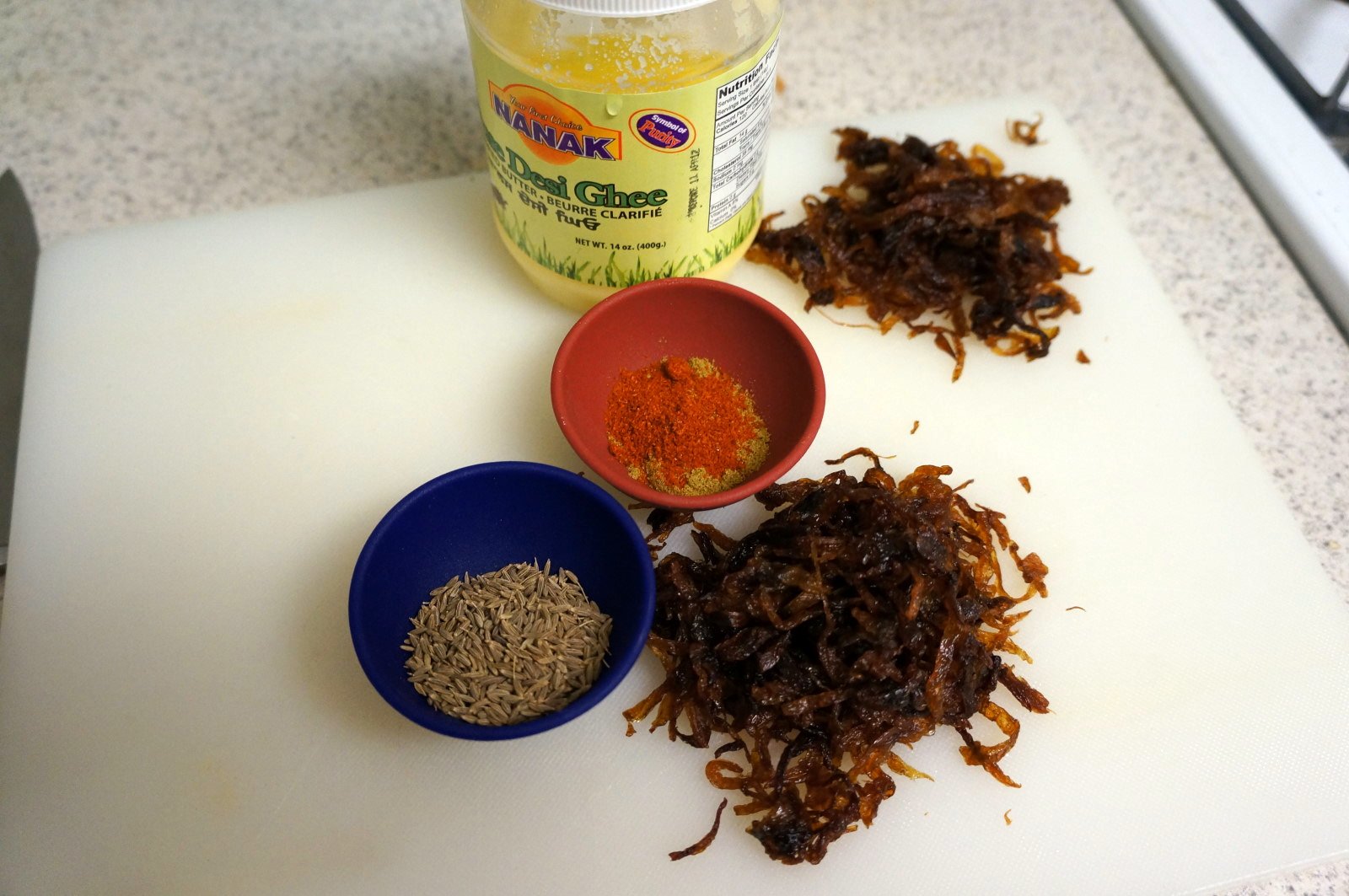
1 tsp zeera seeds whole
1 tsp ground zeera
¼ cup oil (same oil for frying finely sliced onions is ideal, I always keep it in a glass jar)
your boiled meat botis, cool and dry
1 tbs fresh lemon juice
1 tsp ghee or butter for basting the serving dish

Method: 

In a pot with a tight fitting lid: Add oil and zeera, when it sizzles, toss in meat and brown for a couple of minutes. Be gentle so it doesn’t break apart too much. The browning gives flavor but it is already cooked as much as it needs to be.

Toss in ½ o f the fried onions and allow to sizzle for a moment, these are red-brown fried so take care not to blacken them as they are already darkly fried.

Toss in ground spices, allow to sizzle. Before this burns, pour in all of the stock. Allow to come to a boil.

When stock is boiling, add in pre-soaked rice.

Allow stock to come to a boil again. Stir in lemon juice.

All should be bubbling and boiling along nicely. Now, cover and reduce flame to lowest point. Cook for 20 mins covered. After 20 mins, lift lid and allow some steam to escape and turn off flame. Re-cover and allow rice to rest for 10 mins. Resting the rice helps grains stay long and not break apart, as basmati is sensitive.


You will pour this into a large serving dish. I usually butter a deep serving dish like a lasagna pan or turkey broiler pan. Ghee also works well if you prefer that to butter. Before you start the transfer of vessels, put your remaining fried onions in the microwave for about 30 seconds to wake up the flavors. Pour pullao in layers adding a few sprinkles of the fried onion slivers between the layers, adding a final bit on the top layer for looks. Take care not to break the rice, be gentle.

Serve with plain yoghurt, lemon wedges, and if desired, a mild raita.

Left over yakhni can be frozen and used for a plain pullao or as the liquid in gravy. 
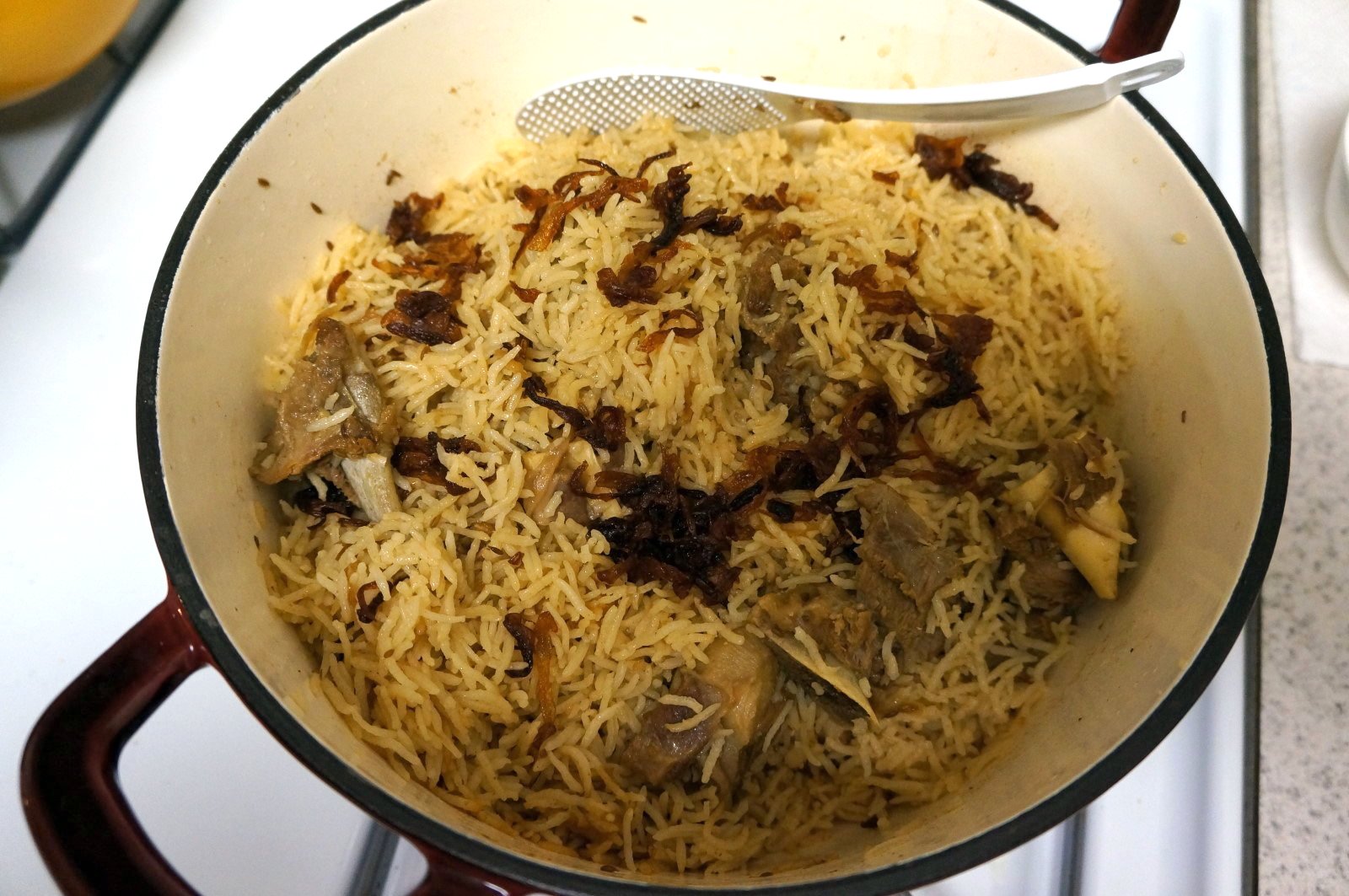

A smaller pullao made on a different day.

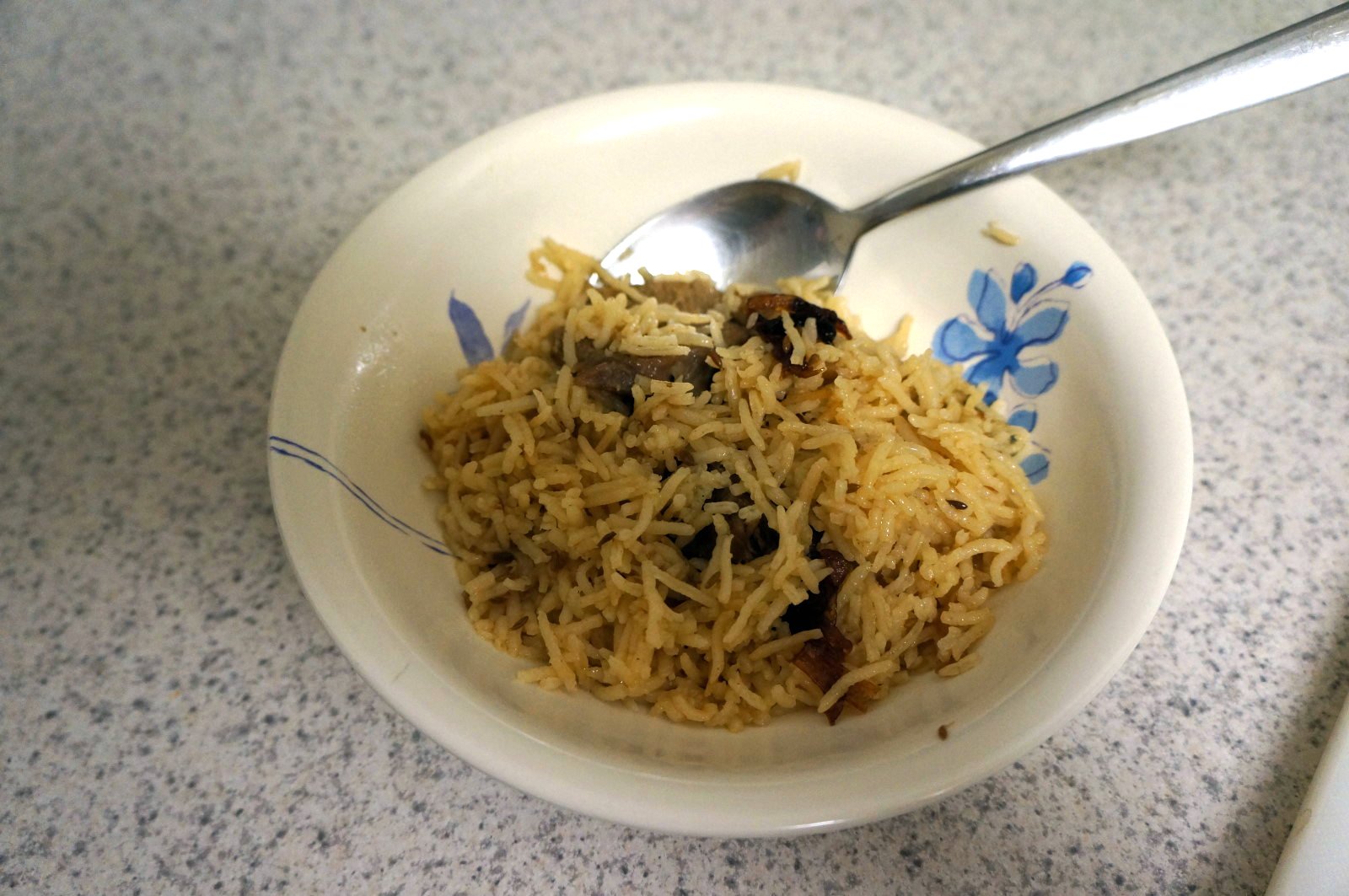
Rice grains lengthen like noodles and are very tender but separate. 


Friday, December 9, 2011

Doab Fish Fry (What to do with Shan Masala)

I have a lot of recipes that are based on adding my own twist to packaged Shan Masala packets. Their qorma, chappli kabab, Sindhi biriani, and a few others are quite good but all need some adaptation to give one's own signature to a dish. Here is what I do with a box of Shan Lahori Fish Mix. Shan Lahori Fish Mix on its own is quite good but extremely salty. It is so salty that if you don't doctor it up, it is inedible. But it is quite convenient to use in that if you were to make a fish fry mix on your own you would need at least a dozen more ingredients than what I have listed below, so it saves time and effort.

I christened this recipe Doab (doh-aahb) Fish Fry since it is a confluence of Shan fish fry and my ingredients, just like a meeting of rivers in The Land of the Five Rivers, Punjab. :)

Doab Fish Fry:

1 lbs Swai fish filets cut into 2-3 inch chunks or large nuggets (or any other white, mild tasting fish like tilapia or king fish)
3 tbs vinegar
1 tsp turmeric
pinch of salt (1/8 tsp)

1 box Shan Lahori Fish Mix
1/4 cup of besan (chickpea flour) plus 2 tablespoons
4 tbs yellow cornmeal
3 pieces of garlic
1 inch of ginger
2 green chiles
2 tbs fresh cilantro finely chopped
1/2 tsp dried mint
1/2 tsp ajwain seeds
pinch of red or orange food coloring powder (optional, I just use it to give a festive look and also so that the end result doesn't seem like I have used Shan Masala stuff from the box or that it is just a fish pakora)
1 tsp lime juice
1 and 1/4 cups water or a little more if the batter looks too thick

oil for shallow frying

Method:

  • Wash fish well and cut into large nuggets. In a bowl, mix the vinegar, turmeric, and salt. Add fish to this and allow to marinate for 1 hour or so. The vinegar will have a slight pickling affect on the fish, so when it is battered and deep fried the fish flesh will be extra creamy and tender against the crisp batter. Yum! The vinegar also removes any unpleasant fishiness from the fish. When you are ready to fry, remove fish from vinegar, briefly rinse the fish and pat dry. 
*Tip: You can also freeze your fish nuggets in the marinade and defrost, rinse, and proceed.


  • Grind together the garlic, ginger, and green chiles to create a fine paste. 
  • In a large mixing bowl, add all of the dry ingredients into the  Shan Lahori Fish fry. Mix well. Stir in the water and the wet ingredients including the ginger-garlic-chile paste and cilantro. Add in the fish and allow to marinade for 1/2 an hour to 1 hour. 
  • Heat oil on a medium-high flame and shallow fry fish on one side, then the other.
  • Serve immediately. You may wish to garnish with a dash of chaat masala or a sprinkle of lime juice but I think it tastes amazing on its own. Serve with ketchup or meethi chutney. For my meethi chutney recipe, see here in this post.
*Tip: I wear disposable kitchen gloves when I handle the fish and wet marinade and batter because I like to mix with my hands to ensure even coating, but I hate the stains of turmeric or food coloring.


Wednesday, April 6, 2011

Where Do You Store Your Masalas?


I have been eyeballing this pricy Tablefare SpiceCare Interlocking spice storage system for a while, but haven't found any in depth unaffiliated reviews of the product. I asked about it on my favorite foodie website, Chowhound, but no one responded to my query. It looks great, though. I am afraid it will cause fumbling and I will have to unlock a lot of stuff all at once to get out a few spices. The SpiceCare thingy was recommended by Chef Bosco Pereira on twitter (@Chef_Bosco), so that's how I found out about it, and I trust what Chef Bosco says a lot. (His tweet soliloquies on South and South East Asian food are awesome. His food-knowledge is as vast as the Seven Seas!) But I'd still like to read some feedback on the product before investing in it.

In my daily cooking, I usually cook the typical dishes of my husband's particular community. For those dishes, I keep the fast moving standard every-dish spices in a masala dabba.  Spices I use less frequently are in clear plastic jars with lids (the little jars are about 16 oz in size, I'd say). They are just all stuffed in the cupboard. There are some I keep at the front of the cupboard, but I step up on a step-stool to dig around for others. I have a friend who keeps all of her spices in a clear plastic jars but keeps the jars in clear plastic stackable storage drawers so the spices are easy to see and take out. Awesome idea! But never got around to doing that. I should really do that, I suppose.
The spices I purchase usually come in large plastic baggies. Here is what I do with the plastic spice baggies: If it is a fast moving spice for me like red chile powder or cumin, I pour some in a plastic jar, some in the masala dabba cup, and then use the tiny bit left over in the baggie first. If it is a very slow moving spice, I pour it into the plastic container, and I toss out the few tablespoons which are left over at the bottom because I know it will go stale before I use it all. It is a waste, I know, but I buy the spices cheaply at the Indian market, so no worries. Before I started tossing them out, I kept the left over amount in its baggie closed with a rubber band, but it would just sit in my cupboard for ages and I would end up throwing it away anyway. For Shan masalas, I mostly use only a couple of teaspoons at a time, so I keep them in the boxes in which they come. For rice and chapati ata, I have them in giant clear plastic locking storage boxes, and for daals, I have them in one drawer in medium sized lockable clear plastic bins.
What about you? If you are a spicy home cook, how do you store your masalas? Any recommendations?

Thursday, September 2, 2010

All about South Asian Qorma (or Korma, or Qormah)

Qorma is one of those dishes that I love to learn and read about and compare recipes. Qorma is also one of those dishes that was traditionally cooked by South Asian Muslims for special occasions and only several times per year, but like biryani, it is now made much more frequently in the homes of the affluent and also in the homes of diasporic desis. Since desi Muslims are the direct culinary inheritors of the Mughlai tradition, the dish is theirs, but it is also widely loved in many interpretations by people of all backgrounds and faiths, and many vegetarian friendly and widely divergent recipes have evolved. (I have seen jackfruit korma!) But traditional versions of qorma are prepared in all of the main former centers of Muslim rule in India and Pakistan.

The word qorma came to South Asia from Central Asia and means "roasted, baked, browned" in reference to meat in Turkic dialects (kavurma). The Persians have their gormeh, prudent Nafees Urdu speakers of duroost shin-qaaf must say it Qormah. In both India and Pakistan it is widely pronounced as korma with no attention given to the Urdu original gutteral /q/ sound, which is approximated as /k/. But in the best Urdu diction it is Qormah/ قورمہ. It is an indeed a dish of Mughal legacy in S. Asia.

At least in South Asia it is traditionally made with mutton although these days chicken, fish, and pure veg. qormas are made to suit different preferences. I make chicken qorma much more often than mutton qorma, just because it is easy and fast cooking. My husband loves mutton qorma, though.

If I happen to be talking to a foodie, I always ask her how she makes her qorma, or how it is made in her community. A Pashto speaking acquaintance (Northern Pakistani) makes a liquidy stew with mutton and vegetables as her qorma. I think for Pashtoons qorma is any stew type dish and this is more in line with the original Central Asian qorma. I had a housekeeper who was a Bangalorean (South Indian) Muslim from a pure Urdu speaking family and she told me that they make their qorma with coconut milk, not yoghurt, and that it is mostly served on holidays and at weddings. My in-laws family (Urdu speaking North Indian origin Pakistani) qorma recipe is more of a typical North Indian Muslim-Pakistani qorma recipe: meat must be browned or well braised, lots of crispy brown fried onions are used (often ground to a paste), yoghurt is the liquid, the seasonings are garam masalas (whole and ground), ginger and garlic paste (heavier ginger to garlic ratio) ground coriander, a pinch of red chile, and at the very end of cooking, a second pinch of garam masala and ground green cardamom, and a tiny dash of keora jal (pandanus flower extract water which you may know as biryani perfume) are added at the very end of cooking...without the dash of pandanus water it doesn't have that qorma perfume taste by their family standards. A layer of oil is floating on the top of the semi-liquidy gravy. It is eaten with naan and basmati rice, never chapati. There is also "white qorma" which doesn't contain browned onions, only onions which are cooked until the rawness is fully gone. Ground almond or ground cashew pastes can be added to make the qorma "shahi" or royal, and also to serve the function of thickening it. Hyderabadis (of India) are known for white qorma. In Kashmir greens and vegetables can be added to the qorma, so it is more like the Central Asian-Persian type concept of qorma.

In my laziness I often use Shan Masala Korma spice mix, just 2 teaspoons, plus homemade garam masala and ground coriander powder, and a dash of roasted ground poppy seeds, but otherwise prepare it as described on the back of the box. I only use very fresh yoghurt (so it won’t have any hint of sourness) and rarely add cream as is prescribed on the Shan box, but if I do, I will add 1 tbs at the very end of cooking just to thicken the gravy. I also make a qorma biryani by using the same qorma recipe, making a slightly thicker gravy (by boiling to dry up the liquid) and then using qorma gravy to layer between parboiled rice then, then close the pot and finish off the rice.

When I am not feeling lazy, I make a more classic Lucknowi qorma based on my mother in law's recipe.

In Indian restos you will get a lot of interpretations of korma. Based on being a dish associated with Muslims, it gets classified in the restaurant 'Mughlai' genre of foods and therefore you will find, in line with the restaurant interpretation of what Mughlai means, lots of cream, nuts and even raisins/sultanas since that is what is taken as 'Mughlai.' This can be a tasty dish, though it doesn't look much like a qorma made in North Indian Muslims-Pakistani homes. I wouldn’t say that's “the wrong way” to make qorma (or perhaps I should write korma here), because it IS made in India by Indians that way, and this type of korma is also what we know at UK and US faux-Mughlai/Punjabi restaurants. Who has the copyright on qorma, anyway? What I see as the “authentic” North Indian Muslim-Pakistani qorma isn't much like the original Central Asian qorma, either. I do have creamy qorma like that at restaurants sometimes, and it is yummy, too.

Here are links to three non-restaurantish, Muslim home style chicken qormas, including one Lucknawi and one from Indian Hyderabad from two good websites, just in case anyone wanted to see a sort of tradional Muslim desi non-resto/no-cream type recipe example. Boneless chicken breast can be used but as far as I know, whether it is chicken or mutton it is traditionally bone-in, and with chicken it would be whole skinless bone-in cut in 12 pieces (not specified in recipes).


http://zaiqa.net/?p=260

The Zaiqa blog (a fave I learned about through Ambhi) is an excellent resource for Hyderabadi recipes...What to me stands out as Hyderabadi about this chicken qorma is that it includes coconut (Southern touch)and roasted peanuts (she used the term "ground nut"). It also has green chile in addition to powdered red chile, plus mint leaves. I don't think those would be in North Indian qormas.
And:


http://www.khanakhazana.com/recipes/view.aspx?id=5311

and

http://www.khanakhazana.com/recipes/view.aspx?id=1405


Khana Khazana is a user-added recipe site, has loads of good Pakistani and Indian stuff. The first qorma is very tradional and Lucknawi with its white poppy seeds (khashkhaash) and extra nutmeg and mace in addition to the garam masalas. The picture doesn't look too yummy but the recipe looks very good IMHO. The other recipe is very similar but without the white poppy seeds. Both users' recipes calls for the kewra water I mentioned above---very traditional.


Note that in all recipes the onions are brown fried seperately and ground to be added to the gravy.


I was happy to see the qorma with -q-, too on the recipes :-) as an Urduphile.


Anyway, just fun to see some regional variation.

Friday, March 26, 2010

Myths and Misconceptions That Americans Have about Desi Food

In the interest of promoting enjoyment of desi cuisines among my fellow Americans, I would like to discuss some misconceived ideas that some times crop up among non-desi Americans regarding desi food.

Indian food is healthy
Most non-desi Americans don't really even consider other desi nations in a culinary manner, they only focus on India. One of our stereotypes about Indian food is that it is very healthy (another reason that we goray log tend to have our racist, ridiculous, self-contradictory stereotypes about South Asians: we often think Indians are all skinny). Indian food IS healthy. Indian food is also unhealthy. There are too many factors at play in any cuisine to categorize it as healthy or unhealthy, especially the cuisines of India and the rest of South Asia. A home made stir fry type vegetable dish is healthy. A samosa or a gulab jaman, not so healthy. Rich, oily, meat and gravy dishes in desi cuisines are not so healthy. Neither is a dish in which all of the vegetables have been briefly deep fried before being added to a gravy. But considering that one may be eating a small ladel of such a dish with healthy boiled rice or whole-wheat flat bread, along with a stir-fried vegetable dish or a boiled lentil dish and some freshly cut vegetables, a balance exists. Many desis do eat too many carbs, especially deep fried carby foods. So do Americans. Carby, rich foods that sustained our ancestors through a day of manual work are not necessary any more. Although our lifestyles have become less active, we still eat as if we were working in a physical capacity all day. We don't burn off the calories we take in. Sound familiar? That a region has healthy as well as unhealthy foods should be obvious. Some non-desi people who are only familiar with desi cuisine through restaurant offerings may think that desi cuisine is filled with ghee, cream, and coconut milk. That is not true either. Home cooked desi 'main dishes' tend to be significantly lighter than what is found in South Asian restaurants. But I think that since Americans have our stereotype about these skinny, healthy Indians, we can even feel disappointed or duped to find that many desi foods are rich or prepared using unhealthy techniques and ingredients. Anyhow, desi food is not entirely healthy or unhealthy. We had our false notions of desi cuisine let down. But it was our own stereotypes that let us down, not the desi food itself.

India is a vegetarian country
This misconception is also related to the above two stereotypes. Vegetarian food is stereotyped as being healthy, so since Indian food is supposedly vegetarian, Indian food is healthy. Since Indian food is healthy, Indians are skinny. The dominoes of stereotypes fall down, clanging against one and other. Okay, there are many vegetarian Indians. However, most Indians are not vegetarians. Certain communities of Indians are associated with being vegetarian. For example, many Gujarati Hindus and especially Jains, Tamil Hindus of certain specific communities (like Iyers), and so on tend to be strict vegetarians. Non-Hindu Indians eat meat. There are a lot of them (+/-20% of the total population). Many, many Hindus eat meat. Some Hindus go through periods of being more religious, and give up meat for this, just like some Americans also go through phases of stronger religiosity. In some regions of India, even Brahmin food is non-vegetarian. Some regions are known for a broadly meat and fish based cuisine. Bengali food as well as the food of Kerala is mainly non-vegetarian. And on and on. Quite simply, India is a place with a wide variety of vegetarian foods, and some cuisines within India are largely vegetarian. However, India is not really a vegetarian country.

I would like to take a moment to address a common myth that I hear Indians or other non-Pakistanis repeat about Pakistani cuisine: Pakistanis only eat meat. This is so untrue. Most of the typical North Indian vegetable standards are eaten in Pakistan, too, with regional variation on exactly how they are prepared. A "proper" Pakistani meal would have a meat dish plus a daal and a vegetable served with rice and chapatti, plus some yoghurt, pickles, possibly a kasaundi (type of pickle) and some fresh salad vegetables layed out on a plate. The meat dish would be the "star" of the table, but the other dishes would be necessary to make the meal well-rounded and complete. Also, many of the "pure" veg dishes of North India are also iconic dishes of Pakistan: vegetarian chaats, dahi baray, karhi pakora, and so on. Although one does find dosai made by Pakistanis of South Indian origin, especially in Karachi, the dosa has not taken over Pakistan as a light meal or snack as it has in North India. But generally speaking, whatever meat and veg. dishes one finds North Indians eating, one will find Pakistanis eating. So it is totally untrue that Pakistanis don't consume vegetables.

South Asian food is spicy
South Asian food can be spicy. Chile heat levels vary again from region to region, family to family, and even between individuals. Non-desi Americans expect that all Indian food should be spicy and chile hot. They feel that milder Indian food is being served to them at restaurants as an adaptation of Indian food cooked to suit the American palate. This is partially true. Some non-desi Americans are grateful for this because they cannot tolerate spicy foods, so they appreciate the adaptation. However, many non-desi Americans do like to eat spicy food. They feel that being served mild food is an insult to their ability to stomach "authentic" desi atomic chile heat. They believe the restaurants are duping them. Okay, it is true that many Indian or Indo-Pak restos that cater to a non-desi clientele cook milder food. However, it is simply untrue that all desi food is fiery hot. Some foods are known to be hot. Some foods are commonly eaten mildly spiced or spiceless on purpose because that is how they are served (like a simple khichri or a daily daal). I recall reading recipe reviews from goras in which they complained that the original Indian recipe for a daily type daal was "bland" or "not spicy enough." Some particular daal dishes are cooked with a lot of chiles and spices. However, often a daily daal is very mild. It is simply boiled and has a light tempering that may include a few dried or fresh chiles, but the dish itself is not supposed to blow your head off. Some desis do like very hot foods and cannot stomach chile-less foods. However, many desis feel that a dish being overly spicy and hot (as well as oily) is a marker of it being poorly cooked. Low quality restaurants serve oily, fiery food for undiscerning customers. Being delicately seasoned is a sign of refinement. "Delicately seasoned" is a subjective description, as to an American person who cannot tolerate any chiles, a "delicately seasoned" desi dish may still be too hot and require copious glasses of water to quench the burning sensation caused by said dish.  Anyhow, my recipes on this blog are probably not spicy enough for chile-heads. The red chile powder and green chile amount can be increased to taste. But Americans shouldn't just assume that desi food has to burn off the tastebuds to be "authentic" or enjoyable.

A side note: I have read on food oriented forums and websites that American goras think that Pakistani food is chile-heat hotter than Indian food. This is not true. What I think is that many "Indian"-labeled  restaurants in the US are serving a less spicy, creamy restaurant genre of food loosely based on authentic Punjabi and Mughlai cuisine, particularly the non-regional-specialty restaurants that target a multi-ethnic (here meaning not just desi) clientele. Regional-specialty Indian restaurants, which mainly target an Indian clientele and are not widely popular among non-desi Americans, use a more "normal" chile heat level, and I am not referring to these types of Indian restaurants here. Pakistani restaurants may keep some of these restaurant-genre Indian items on their menu (jalfrezi, chicken tikka masala, etc). However, in the US I have noticed that restaurants that label themselves as "Pakistani"are often serving more homestyle desi type foods. "Indian" labeled restaurants are more widely popular in the US, and Pakistani restaurants are more likely targeting a Pakistani clientele. Be aware that any "Indian" restaurant can be owned by actual Indians, as well as Pakistanis, desi origin East Africans, Bangladeshis or whoever else. I mean restaurants that are promoted as Pakistani, and not "Indian"-labeled. Anyhow, since these restaurants are serving Southern Pakistani home style cuisine, they are using "normal" amounts of chiles and are not adapting the chile heat for the non-desi customers. So when goras are familliar with a typical generic Punjabi-Mughlai inspired Indian restaurant, which sets the parameters for what they know as Indian food, they must not compare this to the authentic, unadapted Pakistani food. In my hometown, many of the Indian origin people who I know joke that the only desi restaurant that serves "real Indian food" is the Pakistani restaurant. That is because the Pakistani restaurant is serving cream-less homestyle food which very much overlaps with what North Indians eat. So they feel it is much more like "real Indian food" than any of the creamy faux Punjabi-Mughlai "Indian" places. Anyhow, it is not true that "Pakistani food is spicier than Indian food." This is just a misconception based on what is available to us goras at restaurants.

South Asian food is oily
See, I told you the stereotypes we Americans have can co-exist even though they contradict each other. Among the gora's battery of stereotypes about desi food are that it is both healthy AND oily! Non-desi people who delve into authentic desi cooking and look at recipes made by and for desis and not oil-shy, Pam spraying Americans, are often wary of deep fried items, and shocked to find that traditional meat plus gravy recipes can call for 1/4 cup to even 1 cup of oil (like many 'Muslim' recipes). One has to look at it this way: the oil is not to be consumed by one person. The amount of oil is used for a dish meant to feed a large family. The cooking process in many desi cuisines requires some short and long term browning in oil, and reducing the moisture of ingredients by frying in oil. This requires a lot of oil to be done properly (although there are low-fat techniques to use as an alternative), and unlike frying techniques in which the foods are removed from the oil, the oil in these desi dishes is not removed and one adds more ingredients to this oil stage by stage. One can opt to pour off the oil at the end of cooking, or try to get less oil on the serving spoon when ladeling food from dish to plate. I have a friend who drops a dry paper towel on top of a finished dish to absorb some of the oil. One can opt to eat less of these oily meat dishes and go for more vegetables. There are ways to get around the oil. Some regional South Asian food is not particularly oily. However, foods from these regions are not widely available or known to Americans. So not ALL desi foods are oily.

Desi food is too salty
A desi "main dish" is rarely meant to be consumed without rice or bread. The desi dish is conceptualized as dish plus accompanying carb: wet dish with rice or flat bread, dryer dish with flat bread, fancy dish with special naan or kulcha, etc. Since the dish is meant to be mixed with a quantity of carbs, the dish must be highly salted or when it is combined with the carb it will taste under-seasoned. So yes, desi food is salty, but only if you are eating it the wrong way.

A common mistake in desi food consumption
Do not eat a rice dish with a piece of flatbread. Do not mix daal into your biriani. I recall reading a local review of a new restaurant in which the non-desi reviewer said that he mixed his daal into his biriani and mopped it up with his naan. He can eat it that way if he wants to, I guess. But biriani is meant to be eaten alone or with a bit of yoghurt...with some exceptions like a squeeze of lemon juice to lift a dull biriani, or a small bowl of mirch ka saalan in a Hyderabad resto, but I digress. Don't mix daal into your biriani at the Indian resto, O goray doston. It isn't mean to be eaten that way. And choose rice OR bread as your accompanyment. Ne'er the twain shall meet on the plate of the savvy.

I suggest interested readers also have a look at this post, which further discusses regionality among desi food and how that affects non-desis or non-cooking desis who are married to desi men and who would like to learn to cook their husband's regional cuisine.

Thursday, March 18, 2010

Strained Yoghurt Delights


In desi English, strained yoghurt is called hung curd. It is another desi ingredient that you can do lots with. Use it in place of sour cream, or as a base ingredient for dips and spreads. What an amazing substance it is...and you don't have to strain yourself to make it :-P . But how ever do you make it? Start out with some yoghurt, a strainer, a dish to simultaneously hold the strainer and catch the water which separates from the yoghurt, and some kind of thin cloth. For the cloth you can use a very well worn cloth kitchen towel or even a thick, high quality paper kitchen towel, as pictured above. You just lay the cloth into the strainer, prop strainer on top of dish, and dump in some yoghurt. Place this in the fridge and let it strain for about 3 hours or overnight. Seeing the liquid accumulate beneath my strainer gives me a sense of self-satisfaction, though it is a completely effortless procedure to strain. You can make strained yoghurt with full fat or low fat yoghurt.

Now you've strained your yoghurt. What are you gonna do with it? How about...

Yummy Mint Dip


I got this idea from a lovely cooking class I attended. The instructor showed us several dip recipes for strained yoghurt, and after experimenting, I have decided to create my own.

1 cup strained yoghurt
1 heaping tbs dried mint
1 clove of garlic
1/2 tsp or so salt or to taste
1 tsp white vinegar
1 heaping tsp chile flakes (you can use chile powder but it will turn your dip pinkish)
1 tsp honey OR plain sugar OR Splenda
1 tbs sugar free peanut butter (crunchy or pasty is fine)

Take your garlic clove and put it in a small microwaveable bowl of water. Put in the microwave and nuke for 1 minute. Remove the garlic clove from the water and mash it into the strained yoghurt. (Microwaving the garlic reduces its strength and prevents your dip from having an overpowering raw garlic taste) Add in all of the other ingredients and mix very well. Serve as a dip for chips, celery sticks, carrot sticks, etc, or use it in place of mayonnaise on a sandwich.


Sri Khand


Sri Khand is a dessert. I usually associate it with Gujaratis, but I think these days it is widely enjoyed by people of many communities, and you can enjoy it, too because it is killer easy to make. It is silky and somehow light and rich at the same time.

2 cup strained yoghurt (make sure it is very fresh yoghurt and not sour)
2.5 tbs sugar
10 strands of saffron soaked in 1 tbs milk (just add to milk and allow to soak for a few minutes)
1/2 tsp cardamom powder

for garnish: Roasted almond slivers and pistachios, a few strands of saffron

Whip all of the ingredients into the strained yoghurt. Whip for a while to ensure that the sugar completely dissolves. Pour into a serving dish and chill in the fridge for at least 2 hours. Before serving, garnish with the almonds and pistachios and a few more strands of saffron if you like. Dish out into small dessert bowls, or even eat it with hot puris.

In both recipes, low fat yoghurt and Splenda can be used.

Sunday, November 15, 2009

Pressure Cookers: A desi secret


I own and use an Indian stainless steel Hawkins brand pressure cooker (pictured above...though that isn't the one in my kitchen). The gori wife life comes with a learning curve. Since learning to cook desi, there are so many amazing foods, ingredients, and cooking tools that I have come to use quite regularly but had no clue about before. Pressure cookers aren't completely unheard of in the average American kitchen, but they are definately uncommon. However, the pressure cooker is an extremely common cooking vessel in the desi kitchen. Not all desis use them, for various reasons; "all the taste goes," "not traditional way to make X," or "pressure cookers are so lower middle class" are some reasons I have heard for the anti-pressure cooker crowd. However, I love mine and find that is it ever a useful thing to own. I'd like to talk a little bit about using pressure cookers.


First of all, they are very convenient. You can cook daals and meat in a matter of a few whistles (seeTiyan, plural of seeTi in Urdu/Hindi). Whistles? Why do Indian English language cookbooks and recipes refer to whistles? "Cook for 3 whistles." What the heck is a whistle? Well, to know you would have to watch a traditional pressure cooker in action. You add the food and water, you seal the lid, and turn on the flame. The pressure builds, then releases. To release the pressure, steam comes out of the pressure cooker's whistle (regulator). Two to three whistles for most daals, 5 whistles for goat or beef. Like so. I have an Indian pressure cooker. It is traditional. But I have heard that in Amreeka you can get modren pressure cookers that have no seetis. When I relocate to Amreeka, I will have to get one. For now, I am stuck on my seetis. So, you know how you have to simmer beef for 6-8 hours to get it nicely tender? You can pressure cook it for 5 whistles and in about 20 minutes your beef is done. Cooking fuel is expensive in the des for average families, so people save money on cooking gas by using pressure cookers to reduce simmering time. Pressure cookers are economically sound, and good for the environment since they lessen fuel consumption.


There are some downsides to pressure cookers. I love the way large legumes like chickpeas, rajma, and black chickpeas come out in the pressure cooker. They get such a tender texture that allows these legumes to grab on to flavors so well. However, I don't like the end result of how small sized daal comes out. I mean the types of daal that are cooked to a liquidy consistency and are not meant to remain whole. Somehow the pressure cooker makes the liquidy daal fluffy. I don't like the texture. So in my kitchen, I only pressure cook large sized daals which are supposed to remain whole. Secondly, though it is a great meat tenderizer, for me it ruins the taste and texture of beef and goat. The meat also comes out puffy and fluffy. It isn't horrible or anything, but I can always detect pressure cooked meat, and prefer slow simmered meat. I do occasionally resort to pressure cooking red meats as a time saver only. Chicken and fish are a no-no for the pressure cooker, as they would just be obliterated, unless the chicken where you live is quite tough. I do use the pressure cooker to tenderize chicken in specific dishes, though.

After the pressure cooker has done its job, you still have to wait for the pressure created vacuum seal of the lid to release or "fall in." This adds to your cooking time. Some people advise running the pressure cooker under cold water to release the lid. But actually, waiting for the lid to fall in is part of the cooking time of many lentils, so if you release the lid early, the lentils may not be fully cooked in the center. So it is best to wait for the lid to fall in on its own.


The pressure cooker is a necessity in "mehnati" or arduous dishes, like daal makhani. Without the pressure cooker, one would have to babysit this slow simmering daal for 4-5 hours, stirring and mashing away, and adding more and more water as needed. But the pressure cooker reduces your cooking time to 15 minutes of allowing the pot to boil, then waiting for the whistles, and another 10 minutes or so of waiting for the lid. You can't beat that.


I also make stocks in the pressure cooker. For chicken stock that would normally take over an hour, I allow the magic of the pressure cooker to pressurize all of the great flavor out of my stock cuts in around 15 minutes.


You can also use the pressure cooker for some special dishes. For a Lahori style chargha (marinated, cooked, then deep fried Lahore style crispy chicken---recipe coming soon), you can tenderize the chicken so beautifully by giving it one whistle in the pressure cooker, allowing it to cool, and then deep frying. This yields absolutely amazing results.


I know some people who use the pressure cooker for everything. Everything! A friend once told me that people are so stuck on pressure cookers in her part of India, that even their pudding (payasam---South Indian kheer) is pink because apparently milk turns pink in the pressure cooker. Many desi cooks would be lost without it.


Everyone whose family uses pressure cookers had stories of a forgetful auntie who left the pressure cooker unattended and the dang thing exploded, leaving tamaatar saalan stains on the ceiling. So, one should learn from these stories to never leave the pressure cooker unattended and to pay attention to the whistles.


Another note on the small daals: sometimes as they liquify, a tiny piece gets stuck where the steam is supposed to come out, blocking it. This will cause your steam release to spew an ugly yellow daal mess out of the whistle. I have only ever had this happen with daals, but theoretically, any small piece of something could cause the blockage.


I can't wait to use the new modern pressure cookers with their safety features and double seals. But for now, I stick to my old Hawkins quite happily. I advise all people who regularly cook desi foods to invest in one! Luckily mine was cheap over here in Dubai (and it came with a free idli tray!) but I have heard that they can be costly further away from the des.

Thursday, October 22, 2009

Bengali Cooking

I mentioned in this post the importance of understanding the regionality of South Asian food. What if you, a non-desi, or perhaps a desi from a totally different background from your man, marry a guy from a certain place and you have no clue where to begin learning to cook homefoods from his region....which you obviously want to learn becuzzz you lurve your man and want to impress him with your cooking? Girls, you know what I am talking about. Authentic regional South Asian English language cookbooks can be hard to find. There are loads of websites nowadays, but they are not often written for the neophyte desi cook, and contain lines like: Here is a totka, add a chutki of such and such thing, bhunofy, onions turn pink (this is a really weird one for people who have never seen a desi onion)...then put on dam for 30 minutes. Huh? I have learned a lot from cooking websites. I often search through them to compare and prepare recipes to try out for myself. But I really love a good cookbook right there in my hands. I wanted to take some time to highlight books which I have come across which I really liked, and which really helped me learn about the food of a region. I am very interested in regional South Asian cooking, and I have over the years managed to peruse and acquire some English language regional desi cookbooks. I have Kashmiri pandit and waaza books. I have a great Maharashtrian book. I have an Indian Hyderabadi Muslim book, and so forth. Let me start with Bengali cuisine:

There are two books from which I gained a lot of information about Bengali cooking, as well as good recipes.

The first is the excellent tome, Bengali Cooking: Seasons and Festivals by Chitrita Banerji. This is written for any reader, not just a Bengali Indian or Bangladeshi who is already familiar with Bengali cooking terms and ingredients. Banerji writes a narrative about her childhood in West Bengal and then her adult life in Bangladesh. She is originally a West Bengali, but she married a Bangladeshi, so she knows the cuisines of both sides of the border well. Her narratives focus on, as discernable from the title, seasons and festivals, and are interwoven with very good recipes for special foods of those times. Loaded with information, anyone who reads this book will gain very in depth knowledge about the cuisine of the Bengalis, as well as on Bengali culture. The book is well written, informative, gives a beautiful and romantic picture of Bengali culture and foods, and has great recipes.

The second book is Rannaghor by Roopa Sharma. This book, like many Indian cookbooks written for Indians, is not as easily navigable for people who are not very familiar with Indian food terms. So if you are a non-Bengali, especially non-Indian bahu of a Bengali family, you'll have to get a Bengali friend to help you with any unfamiliar terminology or show you some of the special South Asian ingredients until you have learned them all. The author says she wrote the book for the busy, working woman and offers cooking tips and simple recipes to a cook with little time to spare. I don't know about all of that, but I can simply assure you that the recipes are excellent samples of West Bengali homecooked fare. I have made many of the recipes in this book, and I liked all of them. The book can help you set your table with delicious West Bengali fare.

Tuesday, October 20, 2009

Chicken Nihari


I love nihari. Nihari is tradionally a breakfast food. "Nahaar" means day in Arabic, the language of origin of the word nihari. Nihari is a food to start the day with, a morning food to give energy throughout the day. It is eaten with naan in most places, but in Indian Hyderabad it is eaten with the deliciously light and flakey Hyderabadi style paratha. (Nihari recipes vary by region, and niharis of Hyderabad are a bit different than North Indian-Pakistani niharis as well.) Nihari is tradionally made with beef in North India. These days, there are mutton and chicken niharis as well. Nihari is said to be originally from the city of Old Dehli, but outside of its birthplace of India, in neighboring Pakistan, nihari has taken on a life of its own as one of the signature dishes of Pakistani cuisine. In India it is hard to find a dish of nihari at a restaurant, usually a specialty nihari restaurant, after late morning. It is still considered a breakfast food. Nihari is expensive to make at home for common folk, so it is very often bought by the plate at specialty nihari houses. In Pakistan, some people do keep the breakfast tradition. But nihari is more often consumed at any time of day. It is a festive and rich dish associated with Ramadan and Eid.
I will say it again. I love nihari. But, I have been interested in cooking on the lighter side of Pakistani and Indian cuisine, so I had been trying to create a perfect, full bodied chicken nihari since chicken is much lower in fat and calories than beef. I have experimented a bit with online recipes. I have finally settled with a delicious self-created recipe which I am very proud of, and which I hope you will like.
Ingredients:
1 whole skinless chicken, bone in, cut into 12 pieces
1/2 lb of chicken stock cuts, such as necks, backs, and wings
1 onion finely sliced (one American yellow onion or 2-3 small desi pink onions)
2-3 Indian bay leaves (tez patta)
3 pieces of whole black cardamom
1 inch piece of whole cinnamon
6 whole cloves
1 heaping tsp garlic paste
1 heaping tsp ginger paste
1/2 tsp turmeric
1 tsp Kashmiri chile powder (or more to taste)
2 tsp ground coriander powder
1 cup whipped yoghurt
4 cups of water
1 tsp white flour (maida)
2 tsp ground chickpea flour (besan)
1 tsp garam masala
1 tsp freshly ground anise seed powder
1/2 tsp freshly ground green cardamom powder
salt to taste (about 1.5 tsps)
1/4 cup oil
2 tbs oil for thickening flours
Garnish: lemon wedges, chopped fresh cilantro, chopped green chiles, ginger cut into match stick sized slivers
Heat oil and brown the chicken pieces (but not the chicken stock pieces) and remove from oil. Set aside. Heat oil again and in bay leaves, cinnamon piece, black cardamom, and cloves. Once the bay leaves begin to change color, brown the onion by first frying on high heat, then lowering the heat until the slices become crisp and golden brown. Alternatively you can use pre-browned onions. Towards the end of the browning process, stir in the garlic and ginger paste and let this turn golden. Turn up the heat and add in the previously browned chicken pieces, and then the turmeric, chile powder, and coriander powder. Stir for a few moments. Now lower the heat and add in the yoghurt. (you lower the heat to prevent curdling of the yoghurt) Mix well, add in the salt, and stir fry for about 7 minutes on medium heat until the oil rises to the top of the yoghurt. Now add in the chicken stock pieces. Stir to coat with the masala mixture, then turn up the heat and add in the water. Allow the pot to boil, then cover and simmer on low heat for about 30 minutes or until the chicken is cooked.
Once the chicken is done, turn off the heat. Remove the meaty non-stock pieces from the pot and set them aside. Now, without removing the stock pieces, return the pot to a boil and boil on high heat for 10-15 minutes to remove extra water, thicken the gravy, and make the stock rich. When this step is done, you will have about 2.5 cups of gravy. Strain this gravy. You can pick the meat off of the stock pieces and use them for sandwiches laster. Aside from that, all of the spices have done their job, and any undissolved shredds of onion have given off enough of their flavor, and the chicken bones have lent their taste to the gravy. So throw it all away. Keep the gravy ready to use on the side. You can also pour off some of the oil that rises to the top of this gravy. Add water if you have boiled off too much water and have less than 2.5 cups of gravy. Now, heat a clean pan and add in 2 tbs oil. Stir in the white flour and chickpea flour and use a whisk to move this around and smooth out lumps, allowing it to sizzle in the oil and cook through for a minute. Do not allow this to burn. Slowly, 2 tbs at a time, pour in the gravy, continously whisking to avoid lumps. When you have poured in about 1 cup of gravy, go ahead and fully pour in the rest all at once. Allow this to come to a boil to thicken it. Add in the garam masala, anise seed powder, and cardamom powder. Stir this in well. Now re-add the chicken pieces you set aside earlier. Lower heat and keep covered on a very low flame for about 5 minutes. You can also allow this dish to rest a bit and re-heat gently later to allow the flavors to gel for longer.
Decorate with a little of the green garnishes and the match stick ginger, but also serve the garnishes, as well as lemon wedges, on the table with the nihari. Each diner should squeeze in her/his own lemon juice, just a few drops per serving, and add on more of whichever garnishes they like. Eat with whole grain naan to be extra healthy!

Friday, October 9, 2009

Potato with Okra: Aloo bhindi masala


Many goras don't like okra because it comes out slimy. The desi methods of cooking okra can circumvent slimyness. The key is allowing the okra to fully dry after washing. Moisture will bring out the okra slime. Another key is to avoid tossing the okra around too much. Try to avoid moving it too much with the spatula, and the slime will not seep out. Below I mention four methods for cooking okra for a bhindi masala, from deep frying (ideal but unhealthy, to sautee-ing, to cooking in the gravy (some mushiness will occur), to a low fat microwave steam to saute method. The main recipe is something I picked up/adapted from my dear friend Gehana, who does cooking classes in Dubai...see side bar link for more info.

For the okra:

Wash bhindi and allow to air dry. It should be very dry, then make a small slit in each piece and cut the bhindi in two pieces.

If you want the bhindi perfect, no mushyness, cook the bhindi by deep frying till crispy looking (starting to look a bit golden on the sides) and set aside.

You can also gently pan fry in nonstick, covering and sprinkling water until done, without moving them in the pan too much so the sticky slime doesn't come out. They should be about 3/4 cooked if you do the pan method. Set aside.

There is also a way to steam okra in the microwave and then gently saute. You wash and allow to completely dry, clean, and cut the okra. Then you put it in a microwave safe dish with the top of the dish covered in slightly ajar saran wrap. Microwave on high for 4-5 mins. Then you have to allow the okra to completly cool. Then you heat a pan and add 1 tsp or so oil. I have tried with fat free cooking spray but didn't get the best results. Anyhow, you then sautee just to give the okra some crispyness and color. Then you would add it to the cooked masala for 5 mins on low heat.
I have done this with masala stuffed okra and also just plain sprinkled with some pan roasted spices. It works well and I can't say that the taste is as fabulous as deep fried, but it is definately good for something low fat.


The potatoes

For the potatoes: cut about the same size as the bhindi slices, which you can also fry separately and add in at the end, or pan saute, or also cook in the masala.


For the masala:

In a food processor add:
1 onion
4 pieces garlic
1 inch chunk ginger
3 fresh green chiles
2 medium tomatoes
1 tbs coriander powder
1 tsp cumin powder,
1/2 tsp turmeric
1/2 tsp red chile powder
1/2 tsp dried mango powder

Grind all of these ingredients together for your masala.

Heat 2-3 tbs oil in pan, fry the masala paste until the moisture evaporates, adding salt to taste shortly after you add the masala to the pan. When the oil has risen to the top of the masala and it is a thick paste but not fully dry, add the bhindi and lower heat and cook for about five minutes more.


All in one pan method:

You can also cook the potatoes and bhindi in the pan with the masala, but they will get a bit mushy. Some people like it that way though, so it is up to you. For this, cook the masala for a few minutes to dry it up a bit. Then add in the raw potatoes, sautee, and cover for 5 minutes, sprinking a little water. After 5 minutes of cooking the potatoes, add in the okra, stir once well to mix it into the masala, sprinking a little water. Lower heat and cover, steaming on low heat for about 20 minutes. Every five minutes or so, you should open the lid, sprinkle some water around the pan, and shake the pan gently to move the potatoes and okra. Cook until potatoes are tender and by then okra will be done, too.
Garnish:
What ever method you use, garnish with a pinch of freshly ground whole green cardamom.
Tip:
This generic masala paste can be used with many other vegetable combinations: peas and potato, peas and paneer, cauliflour, pea and carrot, and so forth. The options are endless.

Friday, February 13, 2009

Chicken dopiaaza: Chicken cooked in onion gravy


This dish is also called istew and istew dopyaaza. Dopiaaza is a reference to the fact that the dish incorporates bothe sauteed onions and caramelized (bhuna) onions into the gravy. My recipe was passed along to me by my mother in-law. As she is from U.P. originally, this recipe is yoghurt based and doesn't contain tomatoes. It requires whole garam masala (khara masala), as well as powdered garam masala. I keep fried onions ready in my freezer. You can also buy them ready fried at any desi grocer. The sauteed onions are easy to do, but these days you can also get packets of ready sauteed onions at the desi grocer. I also keep pre-ground ginger/garlic paste on hand in the fridge. These ready done items make this dish easy to make, but it is quite easy even if you start from scratch.

You will need:

1 chicken skinned and chopped into botees (bone in)
1 onion chopped finely for sauteeing
1 onion sliced from brown frying (or just use pre-fried bhuni hui pyaaz)
2 tsp ginger paste
2 tsp garlic paste
1 heaping tsp kashmiri chile powder
1 heaping tsp garam masala powder
1/2 cups yoghurt
1 tsp salt
1/2 cup water
2-3 tbs sunflower oil

Khara Masala:
1 cinnamon stick
1-2 bay leaves
5 peppercorns
5 cloves
5 green cardamon pods
1-2 large black cardamon pods
1 tsp cumin seeds

Mix all powdered masalas plus 1 tsp of ginger and 1 tsp of garlic paste into the yoghurt and set aside. Pre-fry sliced onions and set aside. Heat oil in pan. Add in khara masala and fry for a few moments. Add in chopped onions and sautee until the are clear. Add in the rest of the ginger and garlic paste and fry for a few minutes. Stir in the caramelized onions and chicken. Stir around until chicken is browned. Add in yoghurt-masala mixture and salt, plus 1/2 cup water. Bring to a boil. Cover and reduce heat. Cook for about 25 minutes or so until chicken is done (chicken available where I live cooks very fast...it might take yours longer). The dish is ready to enjoy. Serve with basmati rice and/ or naan.

*Tips: I buy a bad of whole mixed garam masala and pick out the ones I need as pictured above, rather than buying individual quantities of each masala. Life is just easier that way.
An alternative style is to add finely chopped tomatoes and allow the water to evaporate from them when the finely chopped onions have melted down a bit and before you add the chicken to bhunofy. I have tried both ways, and both are equally delicious.